Commercial LED Lighting Retrofits in Calgary
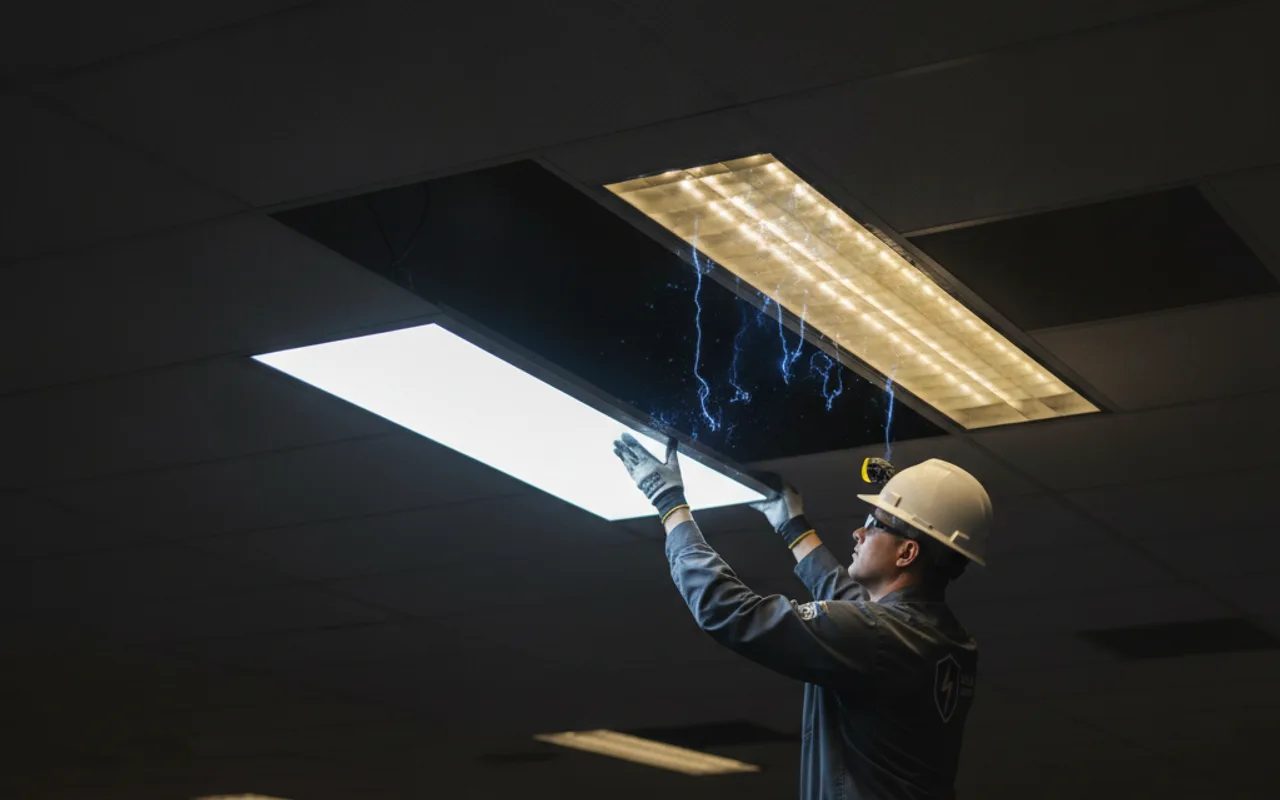
Fluorescent-to-LED conversions for offices, retail floors and warehouses, plus LED replacements for HID parking-lot and exterior fixtures, from retrofit kits in existing troffers to new high-bay fixtures and occupancy controls. Installed zone by zone around your business hours, with the payback worked out from your own fixture count and power rate.
- Retrofit kits, bypass tubes or new fixtures chosen room by room, not one product for the whole building
- Exit and emergency lighting reviewed at the walkthrough, not left for later
- Occupancy, daylight and schedule controls matched to how each area is used
- After-hours and phased installs so your business stays open
- Payback worked out from your fixture count, operating hours and power rate
- Rebate and financing status checked when we quote, not promised up front
Fluorescent tubes are being phased out in Canada
Under federal amendments to the Products Containing Mercury Regulations, making or importing straight fluorescent tubes for general lighting has been prohibited as of December 31, 2025. Replacement tubes for fixtures already in service can be imported or made only until December 31, 2027, and selling those replacements is prohibited after December 31, 2029. Environment and Climate Change Canada notes that linear fluorescent lamps contain mercury, and the government's impact analysis describes LED lamps as more energy efficient, mercury-free and longer-lasting. For a building owner, the question is no longer whether the tubes go, but whether you retrofit on your own schedule or scramble once replacements get scarce. Starting now also lets you spread the work across quarters or floors instead of doing it all at once.
Four ways to convert a fluorescent fixture
Not every LED conversion is the same job. The quickest is a direct-replacement tube that runs on the existing ballast: little labour, but the old ballast stays in the circuit as the next part to fail, and tube and ballast have to be compatible. A ballast-bypass tube removes the ballast and feeds line voltage straight to the lampholders. It's efficient, but that fixture must never take a fluorescent tube again, which is why each converted fixture should carry a clear label for whoever relamps it next. A retrofit kit replaces the tubes, ballast and reflector inside an existing housing with an LED assembly and driver, leaving the ceiling grid alone. A new fixture makes sense when housings are yellowed or damaged, the layout is wrong, or you're lighting a high-bay space. Most buildings end up with a mix, chosen room by room.
Offices, retail, warehouses and exterior lighting
Each kind of space asks something different of the new lighting. Offices need even, low-glare light across desks and screens, usually from troffer kits or flat panels that drop into the existing grid. Retail floors need colour that makes the product look right, plus accent lighting that can be re-aimed when displays change. Warehouses and shops need high-bay fixtures matched to mounting height and racking, with bright, even aisles and loading docks where forklifts and people share the floor. Outside, wall packs, canopy lights and parking-lot fixtures on photocells or timers keep entrances and lots lit after dark. We look at how each area is used before choosing fixtures, so a stock room doesn't get the same treatment as a showroom.
Controls that switch the lights off for you
Swapping fixtures only changes how much power each light draws while it's on; controls decide how long it stays on. Occupancy or vacancy sensors turn lights off in washrooms, storage rooms, meeting rooms and quiet warehouse aisles when nobody's there. Daylight sensors dim fixtures near windows and skylights while the sun does the work. Schedules and photocells stop exterior lighting from burning through a bright afternoon. Daylight dimming needs dimmable drivers, and every control needs careful setup: a time delay that's too short leaves people waving their arms in the dark, and a sensor that sees the hallway switches on for every passer-by. Each one has to be set and tested on site against how the space is really used, and the switching should stay simple enough that nobody needs a manual.
Exit signs and emergency lighting are part of the job
A retrofit is the natural time to look at exit signs and emergency lights, which often still run older incandescent or fluorescent lamps. They're life-safety equipment, not décor: for commercial space, the City of Calgary's permit rules put emergency lighting, along with fire alarm and HVAC, under the base-building electrical permit, and list tenant spaces as a separate permit. In a multi-tenant building, that usually means coordinating with the owner or property manager before anything on those circuits changes. We check how your exit and emergency lights are fed, flag units due for replacement, and add them to the scope once it's clear who is responsible for them. That keeps a lighting upgrade from opening a life-safety gap that someone else discovers at the next inspection.
Installing around your business hours
A retrofit shouldn't close your doors. We phase the work by zone, floor or aisle and schedule it after hours or on weekends where the space can't go dark during the day, so staff arrive to finished areas instead of ladders. In warehouses we plan lift access around racking and shipping times. Desks, stock and equipment under the work are covered or moved with your okay, and each zone is cleaned up before we leave it, because clean, efficient service is how we work. Old tubes contain mercury, so they don't belong in the dumpster. Environment and Climate Change Canada directs them to Product Care Recycling depots where a provincial light-recycling program exists, or otherwise to the municipality. How the old tubes and ballasts will be handled is agreed in the quote, before any work starts.
Working out payback without guesswork
We don't quote a savings percentage off a brochure; payback comes from your building's numbers. We count every fixture by type and note its wattage, ballast included, confirm how many hours a year each area is actually lit, and apply the energy rate from your bill. That gives today's annual lighting cost. We run the same numbers for the proposed LED fixtures and controls, then add what you'll stop spending on tubes, ballasts and the labour or lift rentals to replace them. Divide the installed cost by the yearly savings and you have a simple payback you can check yourself. An area lit around the clock usually pays back far sooner than a storeroom used a few hours a week, which is why results vary so much within one building.
Rebates and financing: what's actually open
Honest answer: as of September 2026 we aren't aware of an open provincial or federal rebate for typical commercial LED retrofits in Calgary. Emissions Reduction Alberta's Energy Savings for Business program, which covered lighting, has awarded all its funding and is closed to applications. The City's Commercial Clean Energy Improvement Program (CEIP) is financing, not a rebate: up to 100 percent of project costs to a $1 million maximum, repaid through the property tax bill over up to 20 years, and its intake is paused. Its lighting list includes DLC-certified troffer and bay fixtures and retrofit kits, LED exit signs and bundled controls, but no LED lamps of any kind, and it needs an energy audit and approval before work starts. Industrial and manufacturing sites can join ERA's SEMI waitlist. We check what's open when we quote.
We retrofit lighting in offices, retail bays, restaurants, shops and warehouses across Calgary, and for businesses in Airdrie, Cochrane, Chestermere, Okotoks, Strathmore, High River and Rocky View County. Calgary's Commercial CEIP is limited to privately owned, non-residential properties inside the city and excludes industrial property, so if intake reopens we'll tell you early whether it's even in play for your building. Outside Calgary, the same walkthrough, payback method and phased schedule apply.
Commercial LED Lighting Retrofits — your questions, answered
Can I still buy fluorescent tubes in Canada?
For now, but supply is shrinking. Under federal mercury regulations, importing and making straight fluorescent tubes for general lighting is prohibited as of December 31, 2025. Replacement tubes for existing fixtures can be imported or made until December 31, 2027, and selling them is prohibited after December 31, 2029. Planning the switch now avoids a rushed one later.
Should I retrofit my existing fixtures or replace them?
If the housings are sound and the layout works, retrofit kits are usually the tidiest option: new LED components inside the existing troffer and no ceiling work. Replace the fixture when housings are yellowed, damaged or badly placed, or in warehouses where purpose-built high-bay fixtures fit better. We decide room by room at the walkthrough.
Are ballast-bypass LED tubes safe?
Yes, when they're installed properly. Removing the ballast sends line voltage straight to the lampholders, so that fixture must never take a fluorescent tube again. Each converted fixture should carry a clear label so whoever relamps it later knows exactly what's inside. Where bypass doesn't suit a fixture, we'll recommend a retrofit kit instead.
Are there LED lighting rebates for Calgary businesses right now?
Not that we're aware of as of September 2026. ERA's Energy Savings for Business program is closed, and Calgary's Commercial CEIP offers financing repaid through property taxes rather than a rebate, with intake currently paused. Industrial and manufacturing sites can join ERA's SEMI waitlist. We check the current status of each program when we quote.
How long does a retrofit take, and can you work after hours?
It depends on fixture count, ceiling heights and how much of the space can be worked on at once, so we set the timeline at the walkthrough. We phase the job zone by zone and schedule it after hours or on weekends wherever the space needs to stay lit and open during the day.
Do you handle permits and exit signs?
Yes. Whether a permit is needed depends on the scope, so we confirm it at the walkthrough and pull it when the work requires one. The City of Calgary includes emergency lighting in the commercial base-building permit scope, so exit and emergency lights are coordinated with the building owner rather than swapped quietly.
Related electrical services
Ready to book commercial LED lighting retrofits in Calgary?
Tell us about your project and we’ll reply with a clear scope and an up-front price — permit and inspection included, no surprises.
Request a free quote