What acreage electrical work actually costs around Calgary — well pump circuits, shop sub-panels, buried feeders, and standby power, priced honestly.
Acreage electrical work in Rocky View County, Cochrane, Airdrie, and the Foothills is a different job than a typical in-town service call, and the cost reflects it. Wiring the electrical side of a well pump — the dedicated circuit, disconnect, and controls, separate from the pump and pressure tank themselves — typically runs $800 to $2,500 in the Calgary area, depending on how far the wellhead sits from your panel and whether the run needs trenching. A detached shop or barn sub-panel, fed by a buried conductor from the house, is a bigger project: budget roughly $4,000 to $8,000 for a straightforward 100-amp shop on a 30- to 50-metre run, and $8,000 to $14,000 or more for a larger 200-amp shop carrying heavy tool or heating loads.
“Quick answer: wiring the electrical side of a well pump — circuit, disconnect, and controls, not the pump itself — typically costs $800 to $2,500 in the Calgary area. A detached shop sub-panel runs $4,000 to $14,000 depending on distance and amperage. Distance from your existing panel moves both numbers more than anything else.”
Why acreage electrical is its own category of work
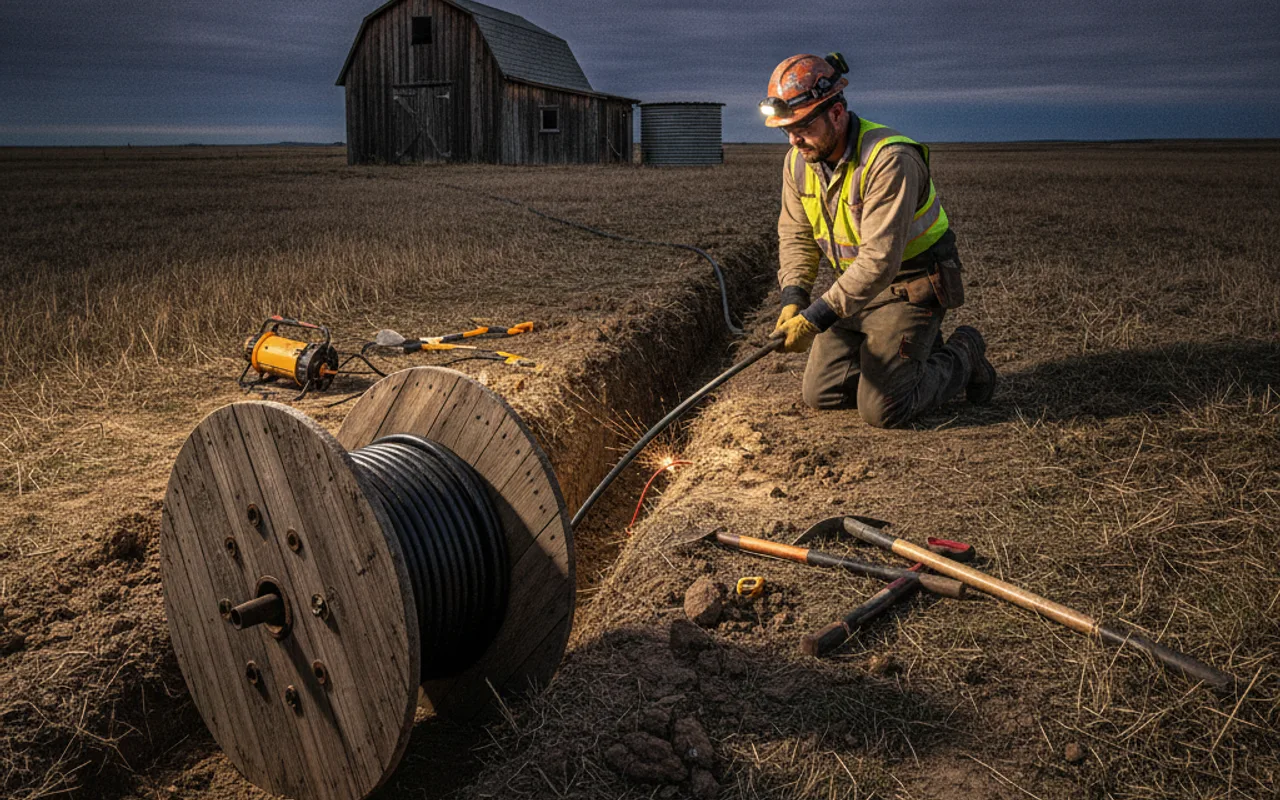
In the city, most electrical jobs happen inside walls a few metres from an existing panel. On an acreage, the wellhead might sit 40 metres from the house, the shop another 60 metres past that, and every one of those runs has to be trenched, buried to the right depth, and protected from Alberta's freeze-thaw cycle. Loads are different too — block heaters, stock tank heaters, welders, air compressors, and irrigation pumps show up on acreage properties far more than in a typical subdivision, and they add up fast on a panel that was sized decades ago for a house alone.
“On an acreage, the wire run is usually the biggest line item in the job — not the panel, not the breaker. Distance from your existing service to the shop or the wellhead decides the price more than anything else.”
Well pump wiring — what it actually costs and requires
Most submersible well pumps run on a dedicated 240V circuit, sized to the pump's horsepower and starting current — commonly protected by a 15 to 30 amp breaker, though larger pumps need more. The circuit runs from your panel to a disconnect installed at or near the wellhead or pressure tank, with the pump's control box and pressure switch wired in along the way. Because the run is almost always underground and often crosses open yard or pasture, direct-buried cable or conduit rated for wet, direct-burial conditions is the standard approach — not the cable used inside a house.
- Distance from your panel to the wellhead — the single biggest driver of cost.
- Pump size and horsepower, which set the wire gauge and breaker rating.
- Whether it is a new well or a rewire of an existing one with old, undersized, or failing conductors.
- Panel capacity — a load calculation confirms your service can carry the pump alongside everything else on the property.
Shop, barn, and outbuilding sub-panels
A detached shop or barn almost always gets its own sub-panel rather than a handful of long branch circuits run from the house — it is safer, easier to expand later, and keeps the shop's breakers where you actually use them. Sizing depends on what the shop needs to run: lighting and a few outlets is a modest load, but add a welder, an air compressor, in-floor or overhead heat, and a couple of block heaters, and a 100-amp sub-panel can fill up faster than people expect.
- Short run under 30 metres to a 100A shop sub-panel: roughly $4,000 to $6,500 installed.
- Longer run of 40 to 60+ metres, common on larger acreages: $6,500 to $9,000.
- A 200A shop sub-panel for heavier tool, welding, or heating loads: $9,000 to $14,000 or more.
- Planning for heat, a welder circuit, or a second building later — size the conduit and panel space now, since trenching twice costs far more than trenching once.
“The same load calculation we run before an EV charger or a panel upgrade applies just as much to a shop — a welder, a compressor, and a couple of block heaters running together can pull more than the panel was ever sized for.”
Buried feeders and Calgary-area frost depth
Every acreage run that crosses open ground has to deal with Alberta's frost line, and the code requires buried conductors to sit deep enough to stay protected from ground movement and physical damage — deeper under a driveway or anywhere vehicles cross than under a lawn or pasture. Your electrician selects the exact depth and conduit type for the specific run, the conductor, and the soil conditions, but the practical result is the same either way: a trench that goes in right the first time, because reopening a 60-metre run to fix a shortcut is a far more expensive problem than doing it properly at the start. As we've covered in our guide to hot tub wiring in Calgary, the same underground principles apply anywhere a run leaves the house and crosses open yard — acreage properties just do it at a bigger scale, more often, and across more outbuildings.
Overhead vs. underground, and who you are actually coordinating with
One detail that surprises a lot of acreage owners: the utility on the other end of your service may not be ENMAX. ENMAX is the distribution utility inside Calgary city limits; most of Rocky View County, the Foothills, and the rural areas around Airdrie, Cochrane, Okotoks, and Strathmore are served by FortisAlberta instead. That matters for anything involving the utility side of your service — a new connection, an upgrade, or a transformer change goes through Fortis, not ENMAX, and the coordination and timelines can differ from what a city homeowner is used to. Your electrician manages that coordination either way, but it is worth knowing which utility you are actually dealing with before you start asking about timelines.
Standby power matters more on acreage
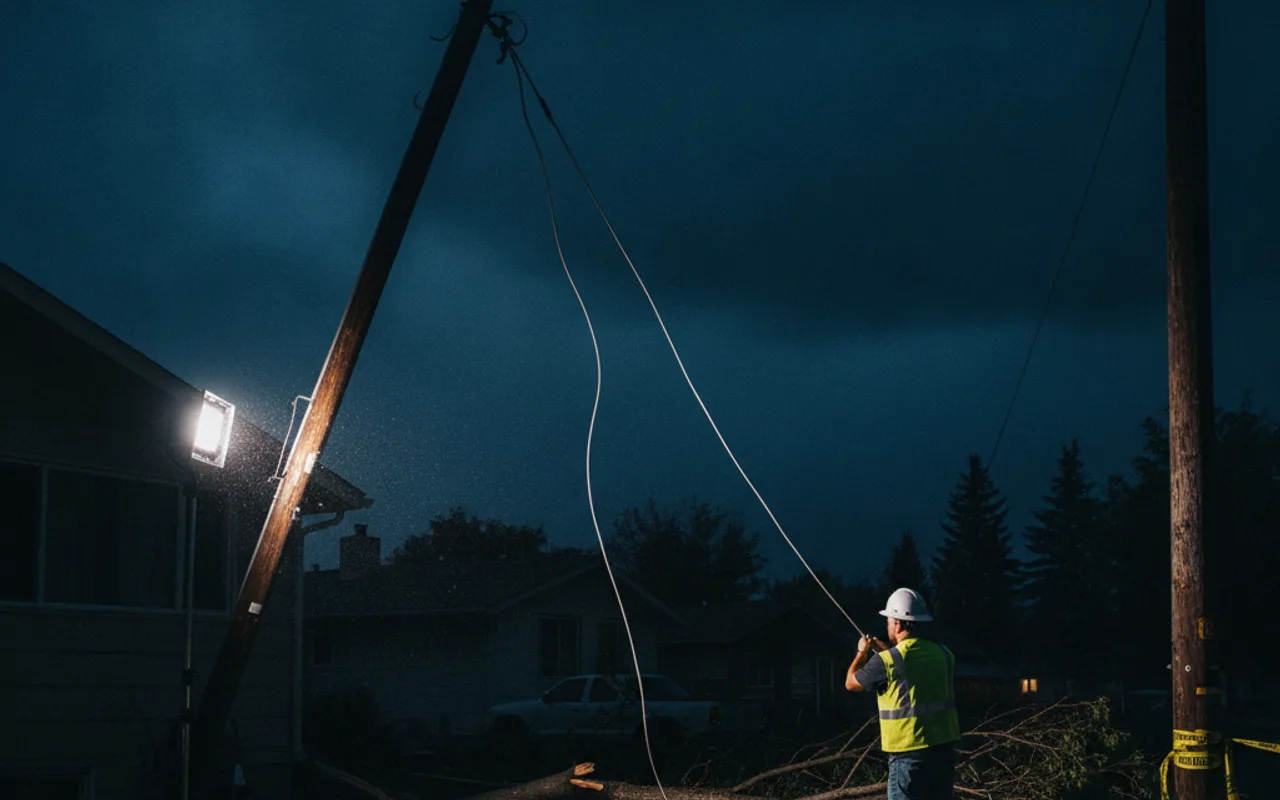
A power outage in town is an inconvenience. On an acreage, it can mean the well pump stops delivering water, a septic system's alarm can't warn you, and a heated shop starts losing its battle with a Calgary winter within hours. As we've covered in our guide to backup generator installation in Calgary, a manual interlock kit for a portable generator runs roughly $700 to $1,500, while a whole-house standby system with an automatic transfer switch typically runs $8,000 to $16,000 — and acreage properties sized to carry a well pump, septic controls, and a shop often land at the higher end of that range, sometimes $16,000 to $24,000 or more for a larger property. If a shop or well project is already on your list, it is worth having the standby power conversation at the same time — the trenching and panel work often overlap.
Permits — Rocky View County and the Foothills work differently than Calgary
Acreage properties in Rocky View County, the Foothills, and other rural municipalities around Calgary fall outside the City of Calgary's permitting system. The same Canadian Electrical Code applies, but it is administered through Alberta's Safety Codes process rather than a City of Calgary permit — the same distinction that applies to commercial work outside city limits. A licensed electrician handles this regardless of which jurisdiction your property sits in, but it means the permit path for a shop sub-panel in Springbank or a well pump circuit near Priddis looks a little different on paper than the same job inside Calgary, even though the safety requirements are identical.
Questions acreage owners ask us
My well pump breaker keeps tripping — is that electrical, or just the pump? A breaker that trips repeatedly is doing its job by protecting the circuit, and it is worth taking seriously either way. Sometimes it is a failing pump or pressure switch drawing more current than it should; sometimes it is a wiring or connection problem in the circuit itself. An electrician can test the circuit in minutes to tell you which one you are dealing with before you spend money guessing.
Should the shop and the house share one service, or run on separate services entirely? For most acreages, a single main service with a dedicated sub-panel feeding the shop is the standard, cost-effective approach — it centralizes your metering and keeps the utility relationship simple. A fully separate service to the shop is sometimes worth it for very large or heavy-load outbuildings, but it is a bigger project and a conversation worth having with your electrician before you commit to a design.
Can I wire my own well pump or shop panel? Alberta's homeowner permit rules allow eligible owner-occupied work, but a buried, wet-location well circuit and a properly sized sub-panel are exactly the kind of work where a mistake is invisible until it fails — often outdoors, underground, and expensive to dig up and fix. Most acreage owners are better served having a licensed electrician design and install this work, then pulling the permit and inspection that confirms it was done right.
How far ahead should I book acreage electrical work? Trenching and outdoor work are easiest to schedule in the warmer months, and a shop or well project often gets tied to a building or drilling timeline that is out of your electrician's control — so book as early as your plans firm up, especially if you want the work done before ground freezes in the fall.
From well pump circuits and shop sub-panels to buried feeders and standby power, the team at Shock Stop handles acreage and rural electrical across Rocky View County, Cochrane, the Foothills, Airdrie, Okotoks, and Strathmore — licensed, permitted, and priced honestly for the realities of running wire across open ground. Reach out for an on-site assessment of your property and a straight quote before you break ground.