If your home has a Federal Pioneer panel, Calgary homes built 1960–1990 are in the prime risk era. Here is the fire risk, insurer impact, and 2026 replacement costs.
Federal Pioneer Stab-Lok breakers have a documented failure mode — they do not trip when they should, allowing an overloaded circuit to overheat instead of cutting out. That is a fire risk, and Alberta insurers are treating it as one. If your home has a Federal Pioneer panel, Calgary's 1960-to-1990 housing stock means there is a real chance it is still in service — sold under the Federal Pioneer name in Canada, though identical in design to the U.S. Federal Pacific Stab-Lok panel.
“A Stab-Lok breaker does not fail by tripping too easily — it fails by not tripping at all. An overloaded circuit that should cut out instead stays live and gets hot. That is what makes this panel different from simply being old.”
What Federal Pioneer actually is — and why you may have one
Federal Pioneer was the Canadian subsidiary of Federal Pacific Electric Company, the U.S. manufacturer. These panels were installed widely in residential construction across Calgary through the 1960s, 1970s, and into the 1980s — meaning communities like Brentwood, Varsity, Glendale, Palliser, Lake Bonavista, and thousands of inner-city homes in Calgary's established neighbourhoods are in the prime age range. Federal Pacific is the name that appears in most American resources about this panel. Federal Pioneer is the name you will see on panels in Canadian homes — and that distinction matters when you are searching for accurate local information.
If your home was built between 1960 and 1990 and has never had an electrical panel upgrade, there is a real chance the original Federal Pioneer panel is still in service. The only way to confirm is to open the panel door and look at the breaker brand. A licensed electrician can confirm it in minutes on a service visit.
The failure mode — how Stab-Lok breakers work against you
A circuit breaker has one job: interrupt a circuit when the current flowing through it exceeds what the wiring can safely carry. When a circuit is overloaded — too many devices drawing too much current — the breaker should trip, cutting power before wires overheat.
Federal Pioneer Stab-Lok breakers have been shown through independent testing to fail to trip at rates that far exceed acceptable thresholds. A breaker that does not trip when it should allows an overloaded circuit to keep drawing current, heats the wiring, and in the worst case starts a fire inside the wall. This is not a nuisance-tripping problem — it is the opposite: a breaker that provides no protection under the exact conditions it was designed for.
The failure is not always visible. A Stab-Lok breaker can appear functional for years — tripping occasionally on clear overloads — while silently failing on the sustained overloads that matter. There is no indicator on the panel that tells you a breaker has degraded to that state.
How to identify a Federal Pioneer panel in your home
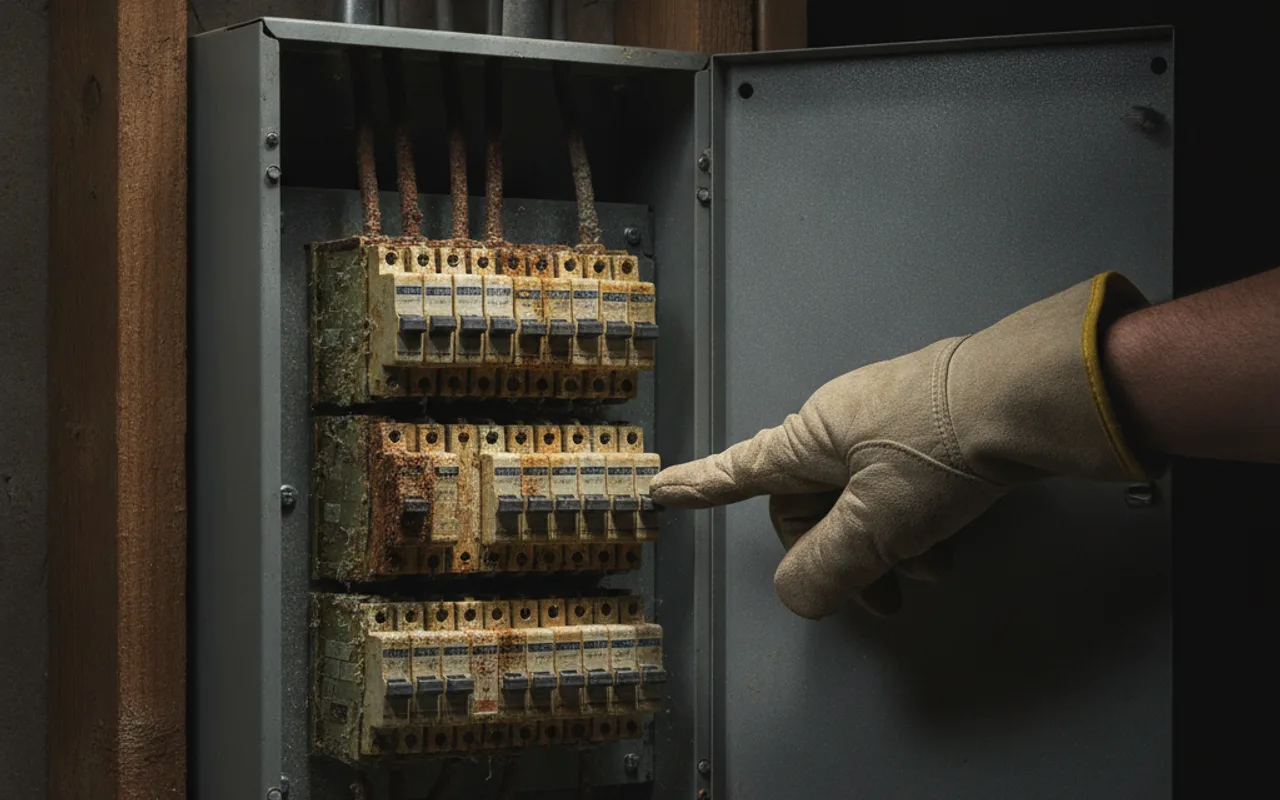
Open the panel door — without touching the wiring or the main breaker — and look for:
- "Federal Pioneer" or "FP" stamped on the individual breaker bodies.
- "Stab-Lok" branding on the breaker faces or inside the panel enclosure.
- A small red indicator window on the face of each breaker.
- Narrow half-inch-wide breakers that slide into bus stabs rather than snapping into a clip.
- An older-style grey or beige metal enclosure, often without a main shutoff breaker visible at the top.
If you are not comfortable opening the panel, a licensed electrician can confirm the panel type on a service call. The visual check takes less than a minute.
The insurance problem in Alberta
Alberta home insurers have taken a clear position on Federal Pioneer panels: they are a known, documented risk, and many insurers will not write or renew a policy on a home that still has one. The range of consequences includes a higher premium with a remediation requirement, a condition to replace the panel before the next renewal, or outright refusal to insure.
This is not a theoretical future risk — it is a present-day issue for Calgary homeowners with these panels. It extends across the region too: homeowners in Airdrie, properties in Okotoks, and acreage homes across the Foothills face the same insurer scrutiny, because the risk is panel-specific, not geography-specific.
The insurance implication surfaces at two moments: at purchase, when a home inspector flags the panel and the buyer's insurer may refuse coverage or demand remediation before funding; and at annual renewal, when an underwriting review or a claim brings the issue forward. As we explained in our guide to electrical permits in Calgary, a permitted and inspected panel replacement is the documentation both an insurer and a future buyer need to confirm the issue is closed.
“The permit and inspection record from a panel replacement is the document that closes the Federal Pioneer file with an insurer. Keep it with your home records.”
Does it need to be replaced immediately?
There is no single answer, but the right framing is when, not whether. A Federal Pioneer panel that has served a home for decades without a visible incident does not have a clean safety record — it has a record of not having caused a problem yet. The failure mode is a probability that compounds with load and age, not a countdown timer.
The factors that increase urgency:
- Your insurer has flagged the panel and issued a formal remediation requirement.
- You are planning to add significant new loads — an EV charger, a hot tub circuit, or a secondary suite — that will stress the panel further.
- A home inspection has flagged the panel in connection with a purchase or sale.
- The panel shows physical signs of age: corrosion around breakers, discolouration inside the enclosure, or breakers that feel loose.
- The home also has aluminum branch wiring — a compounding concern common in the same construction era, which we address in our [aluminum wiring safety guide](/blog/aluminum-wiring-calgary).
If none of these apply and you are not under insurer pressure, you are not in an immediate crisis — but the question belongs on the short list, not the back burner.
What Federal Pioneer panel replacement costs in Calgary in 2026
Replacing a Federal Pioneer panel in Calgary means installing a new main panel — in most cases a modern 200-amp main breaker panel replacing the original 100-amp Federal Pioneer service. The process involves the licensed electrician pulling a City of Calgary electrical permit, ENMAX (Calgary's distribution utility) disconnecting and reconnecting the service at the meter, the electrician completing the panel swap and reconnecting all circuits, and the City inspection that follows to sign off the work. ENMAX coordination typically adds one to two business days to the overall timeline and is something your electrician handles on your behalf.
- Overhead service — 100A Federal Pioneer replaced with 200A panel and service, single family home: $4,000–$6,000 all-in including permit and ENMAX coordination.
- Underground service (supply from below grade): $5,500–$8,000 or more, driven by additional trenching and utility coordination.
- Panel replacement on an existing 200A service (panel is Federal Pioneer but the service is already 200A): $2,500–$4,000.
As we covered in our detailed breakdown of panel upgrade costs in Calgary, those ranges reflect the all-in cost — new panel, permit, meter base work, labour, and inspection. If you are replacing the panel anyway and your service is still 100A, upsizing to 200A at the same time is almost always worth the modest incremental cost: a modern 200-amp service opens the door for an EV charger, a hot tub, and any future loads without revisiting the panel again.
Questions Calgary homeowners ask about Federal Pioneer panels
Can I just replace individual Stab-Lok breakers instead of the whole panel? Replacement Stab-Lok breakers compatible with Federal Pioneer panels are generally no longer manufactured by the original supplier. Aftermarket alternatives exist but carry their own reliability questions. The industry-standard remediation is a full panel replacement — a licensed electrician will give you the same advice.
Will my insurance return to normal after the replacement? In most cases, yes. A permitted and inspected panel replacement removes the Federal Pioneer flag from the home's risk profile. Alberta insurers that have issued a remediation requirement will typically restore standard-rate coverage once you provide the permit and inspection documentation confirming the work was completed to code.
How long does the job take? Most residential panel replacements complete in a single day of electrical work. The full timeline from booking to signed-off inspection is typically one to two weeks, accounting for permit processing and ENMAX scheduling. If the project also involves a service change — from overhead to underground, or a mast relocation — add time for additional utility coordination.
Do older homes in Cochrane, Rocky View County, and Foothills face the same issue? Yes. The Federal Pioneer panel was installed across Alberta, not just within Calgary city limits. Outside Calgary, the electrical permit is pulled through Alberta's Safety Codes permitting process rather than the City of Calgary — your electrician manages this regardless of municipality. The risk, the remediation, and the insurance implications are identical whether the home is in Calgary's Glendale or on a Foothills acreage.
If a home inspector has flagged your Federal Pioneer panel, an insurer has issued a remediation requirement, or you simply want a straight assessment before making a decision, the team at Shock Stop can inspect the panel, explain your options, and give you a clear quote on replacement — permit, ENMAX coordination, and inspection included. Reach out for an on-site assessment and we will give you a direct answer before you commit to anything.