Most Calgary insurers refuse new policies on homes with knob-and-tube wiring — what it is, which neighbourhoods have it, and what a full rewire costs in 2026.
Knob and tube wiring in Calgary is one of the most common surprises a home inspection surfaces in the city's pre-1950s inner-city neighbourhoods. Most Alberta home insurers will refuse to write a new policy on a home with active knob-and-tube wiring — and if you are buying or selling in communities like Inglewood, Ramsay, Hillhurst, or Capitol Hill, there is a real chance this wiring is behind the walls. Understanding what it is, what it means for insurance and a home sale, and what a rewire costs is the difference between a confident decision and a deal-killing surprise.
“Knob and tube wiring is not illegal in Alberta — but most Calgary insurers will refuse to write a new policy on a home with active knob-and-tube circuits, making it one of the most common reasons a Calgary real estate deal falls apart after offer acceptance.”
What knob-and-tube wiring actually is
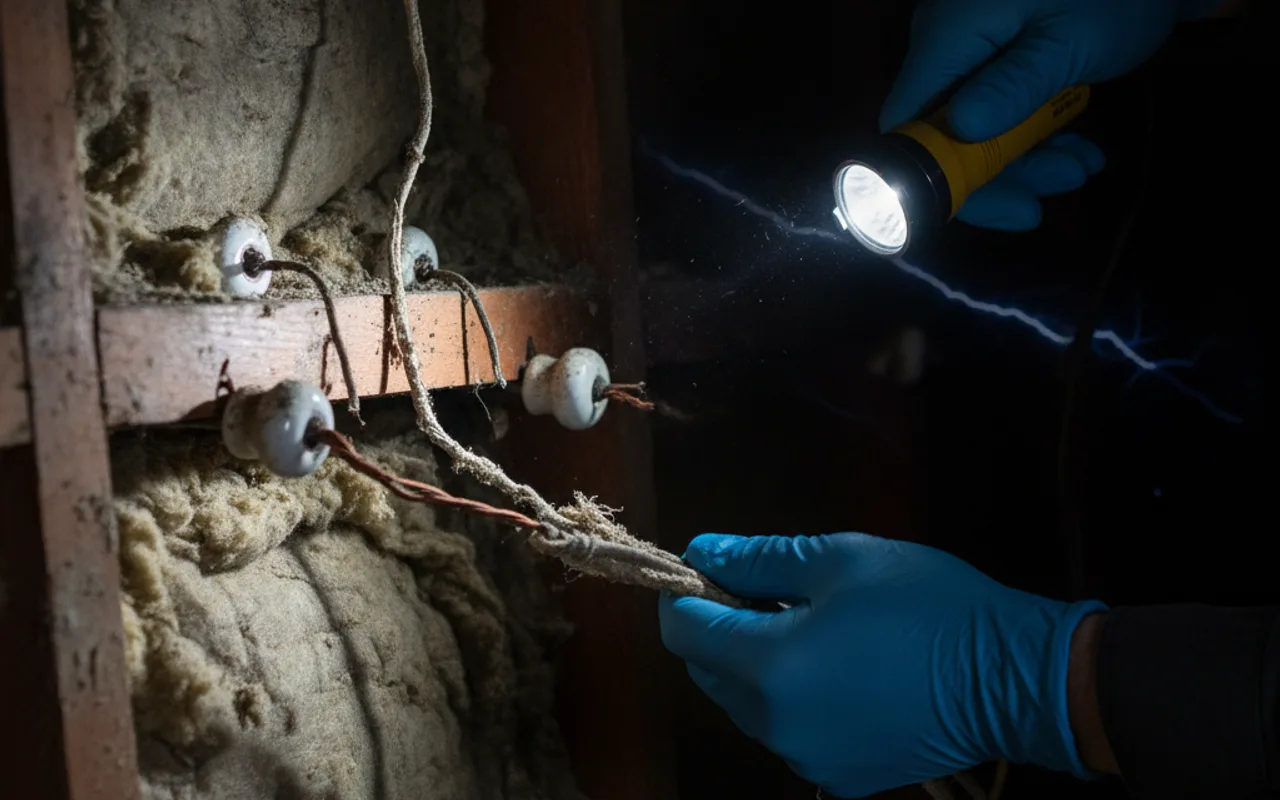
Knob-and-tube (K&T) is an early electrical wiring method used in Canadian homes from roughly the 1880s through the late 1940s. It gets its name from two components: ceramic knobs that anchor the wire to joists and studs, and ceramic tubes that protect the wire where it passes through wood framing. The conductors are single insulated copper wires — one hot, one neutral — run separately through the framing with no ground wire. At that point in electrical history, grounding was not part of the system design.
The insulation on original K&T wire is a cloth-wrapped rubberized compound that was adequate for the electrical loads of a 1920s household. After 75 to 100 years, that insulation becomes brittle, cracks, and in some cases has been compressed, nicked, or damaged through decades of use, pest activity, and well-intentioned homeowner repairs. The connections — typically made at open junction points in attic and crawl space framing rather than in proper covered junction boxes — are a particular concern.
Which Calgary neighbourhoods are most likely to have it
Knob-and-tube wiring is concentrated in Calgary's original and inner-city communities built during the pre-war and early-boom years. If your home was built before roughly 1950, K&T is worth investigating. The communities where we encounter it most often include:
- Inglewood and Ramsay — some of Calgary's oldest residential streets, with homes dating to the early 1900s.
- Hillhurst and Sunnyside — dense inner-city neighbourhoods with large stocks of 1920s and 1930s bungalows and character homes.
- Capitol Hill, Crescent Heights, and Tuxedo Park — established communities with significant pre-war housing.
- Bridgeland and Renfrew — a mix of original and post-war homes where K&T is found in older properties.
- Scarboro, South Calgary, and Mount Royal — early Calgary development areas with homes that predate modern wiring standards.
Shock Stop serves all of these inner-city Calgary communities and has direct experience with the pre-1950s housing stock that comes with them. K&T is less common in communities developed through the 1960s and 1970s — though in that era, aluminum branch-circuit wiring was the safety and insurance concern of that later generation of homes, a topic we cover separately.
Why knob-and-tube wiring is a safety concern
The wire itself, in original undisturbed condition, is not uniquely dangerous compared to other wiring of its age. The problems are cumulative over decades of use and modification.
- No ground conductor — a two-wire system provides no equipment ground. Modern appliances depend on grounding for safe fault clearance and operation.
- Degraded insulation — cloth-wrapped rubber, brittle enough to crack and arc when disturbed, even by vibration or a contractor brushing against it.
- Open splices — K&T connections are often made at exposed junction points in attic framing, not in covered junction boxes as current code requires.
- Insulation buried on top — blown-in attic insulation laid over K&T wiring is a documented fire hazard. K&T relies on air circulation to dissipate heat; burial prevents that.
- Unauthorized modifications — decades of added outlets, spliced-in extensions, and amateur fixes compound the original system's limitations in ways that are difficult to fully document.
Pre-1950s homes with K&T almost always also have original fuse boxes rather than circuit breakers, and those are typically 60-amp services — a fraction of what a modern home's loads actually draw. A full rewire in a home of this age almost always pairs naturally with a panel and service upgrade, since the original fuse box is well past the end of its useful life. Our guide to panel upgrade costs in Calgary covers what that part of the project involves.
The insurance reality in Alberta
Most Alberta home insurers have taken a consistent position: knob-and-tube wiring is a known elevated risk, and most will not write a new policy on a home that still has active K&T circuits. The consequences land at two moments:
- At purchase — the buyer's insurer may refuse coverage or attach a formal condition requiring remediation before the policy takes effect. Without insurance, most mortgage lenders will not fund the purchase. This is the scenario that collapses Calgary real estate deals after an accepted offer.
- At renewal — a home previously insured with K&T may receive a non-renewal notice or a premium increase with a remediation deadline as insurers review their portfolios more actively.
A small number of specialty and non-standard market insurers in Alberta will consider a policy on a K&T home, typically subject to a licensed electrician's inspection letter confirming the wiring has not been compromised and is in acceptable condition. Confirm with your broker which Alberta carriers will consider a K&T inspection letter, as underwriting guidelines change frequently.
The electrician's insurance inspection letter
When an insurer agrees to consider coverage on a K&T home, they typically require a letter from a licensed electrician assessing the wiring. This letter must describe the extent of the K&T present, confirm whether it has been altered or compromised, note whether attic insulation has been buried over it, and flag any deficiencies requiring immediate attention. It is signed and dated by a licensed Master Electrician, and it is the documentation that lets the insurer draw a clear line around the risk.
The inspection and letter typically cost $150 to $350. It begins with a diagnostic visit covering the electrical panel, the attic, crawl spaces, and representative outlet and switch boxes throughout the home. Shock Stop's service and repair team can assess the extent of the knob-and-tube wiring and produce the documentation your insurer needs.
Full rewire vs. partial rewire: your options
When the decision to remediate moves from whether to when, two primary approaches apply.
- Full rewire — all knob-and-tube circuits are removed and replaced with modern copper wiring, grounded outlets, and AFCI or GFCI protection where current code requires it. This is the most complete solution and the one most insurers and buyers prefer. It involves opening walls at outlets, switches, and junction points — work that is staged by area to minimize disruption, but is a genuine renovation-level project in an older home.
- Partial rewire — the circuits most critical for insurance compliance, typically the kitchen, bathrooms, and bedroom circuits, are remediated first. Less-critical circuits in finished living areas or storage spaces are addressed in a subsequent phase. Many Calgary homeowners use this staged approach to satisfy an insurer's immediate requirement while spreading the total cost over a realistic budget and timeline.
Neither approach is universally right. A home where K&T is confined to the attic and a few circuits is a different project than a 1,200 square foot Hillhurst bungalow where every circuit is original wiring. A licensed electrician's assessment scopes the project before you commit to either path.
“A staged rewire is not a compromise — it is a practical approach that gets the most safety-critical circuits to modern standard first, with the rest to follow on a manageable timeline. What matters is that the work is permitted, inspected, and properly sequenced.”
What knob-and-tube remediation costs in Calgary
Rewiring a Calgary home with active K&T wiring is a significant project. Typical 2026 ranges for this market:
- Partial rewire of kitchen and bathrooms — the circuits insurers most commonly require: $2,500 to $5,000, depending on the number of circuits and access conditions.
- Full rewire of a smaller Calgary bungalow (approximately 900 to 1,100 square feet): $6,000 to $10,000 all-in, including the City of Calgary electrical permit and inspection.
- Full rewire of a larger two-storey or 1,400-plus square foot home: $10,000 to $16,000 or more.
- Bundled with a panel and service upgrade — almost always appropriate in a pre-1950s home: add $3,500 to $5,500 to any of the above for the new 200-amp panel and service.
These are market ranges, not quotes. Access conditions, total circuit count, and the state of what has been done to the wiring over the decades all affect the real number. An on-site assessment is the only reliable way to scope and price the job accurately.
Permits, inspections, and the paper trail that protects you
Rewiring work — partial or full — requires a City of Calgary electrical permit and a subsequent inspection by a City electrical safety inspector. As we cover in our guide to electrical permits in Calgary, the permit triggers the independent confirmation that the new wiring is safe and code-compliant. A licensed contractor pulls the permit as part of the job, and the inspection record is the document that closes the K&T file with an insurer and provides a clean paper trail for resale.
For properties outside Calgary city limits — Cochrane, Okotoks, Strathmore, and acreage properties in Rocky View County and the Foothills — the same Canadian Electrical Code requirements apply, administered through Alberta's Safety Codes permitting process rather than the City of Calgary. Your electrician manages this regardless of municipality.
Common questions Calgary homeowners ask
Is knob-and-tube wiring illegal in Alberta? No. Existing K&T wiring that is not currently violating the Canadian Electrical Code is grandfathered under Alberta's adoption of that standard. The insurance market, not the code, is what drives most remediation decisions in practice.
Can exposed connections be taped up to make it acceptable? No — and a licensed electrician or inspector will recognize the difference. Covering K&T connections with tape is not a recognized remediation. It may indicate the wiring has been disturbed and unofficially modified, which often makes the insurer's documentation requirements more stringent, not less.
Do you need to move out during the rewire? For a full rewire, a power interruption is required for portions of the work, but projects are staged so you are not without power entirely for more than a few hours at a stretch. Most Calgary homeowners remain in the home during the project, though the work is disruptive by any measure.
Does knob-and-tube affect resale value? Yes, but the impact depends on how it is handled. An unaddressed K&T flag invites low offers and conditional clauses. A home with documented, permitted, inspected remediation — or a clear scope and honest quote for remaining work — removes the uncertainty and lets buyers make informed decisions rather than guessing at worst-case numbers.
If a home inspection has flagged knob-and-tube wiring, your insurer has asked for a letter, or you are buying or selling a pre-1950s Calgary home and want to understand what you are dealing with, the team at Shock Stop can assess the extent of the wiring, produce the documentation your insurer requires, and give you a clear scope and quote for remediation — with the City of Calgary electrical permit handled from the start. Reach out for an on-site electrical assessment.