What whole-home surge protection costs in Calgary, why most surge damage starts inside the house, and who actually needs one before storm season.
Whole-home surge protection in Calgary is a modest, one-time upgrade — a panel-mounted surge protective device (SPD) typically installs for $300 to $700 — that stands between the small surge that already took out a garage door opener or a furnace control board last year, and the bigger one that could hit your EV charger, your solar inverter, and every smart-home device in the house at once. Most people picture a lightning bolt when they think about power surges, but the events that actually cause damage are far more ordinary, far more frequent, and mostly invisible until something in the house quietly stops working.
“Quick answer: most damaging power surges in a Calgary home do not come from a direct lightning strike — they come from everyday events like a compressor cycling on, a utility grid-switching operation, or a fault somewhere on the distribution line. A Type 2 surge protective device installed at your panel, typically $300 to $700 installed, is the one upgrade that protects every circuit in the house from a single point.”
Where power surges actually come from
A surge is any spike in voltage above what your wiring is designed to carry, and the honest picture is that most surges start inside or very close to the house, not miles away in a thunderstorm. Large motors and compressors — a furnace blower, a fridge, an AC condenser, a well pump — create a small voltage spike every time they switch on and off, because an electric motor draws a burst of current the instant it starts. On their own, those internal surges are minor. Over years, they add up, quietly stressing the electronics plugged in nearby. Utility-side events add a second layer: grid-switching operations on ENMAX's distribution network, a fault on a nearby line, or a transformer issue can all send a surge down the service line into your panel. Lightning is part of the picture too, but usually indirectly — a strike on a line or a tower well away from your home can still travel down the wire and into your panel, which is a different, more common event than a direct hit on your roof.
- Appliance and HVAC motors cycling on and off — the most frequent source, and the one people notice least.
- Utility grid-switching and distribution faults — a normal part of how the grid manages load, and a genuine surge source at the service entrance.
- Lightning-induced surges traveling in through the line — far more common than a direct strike on the home itself.
- A neighbour's large equipment or a shared transformer fault — surges do not respect property lines.
Type 1, Type 2, and point-of-use: what actually protects what
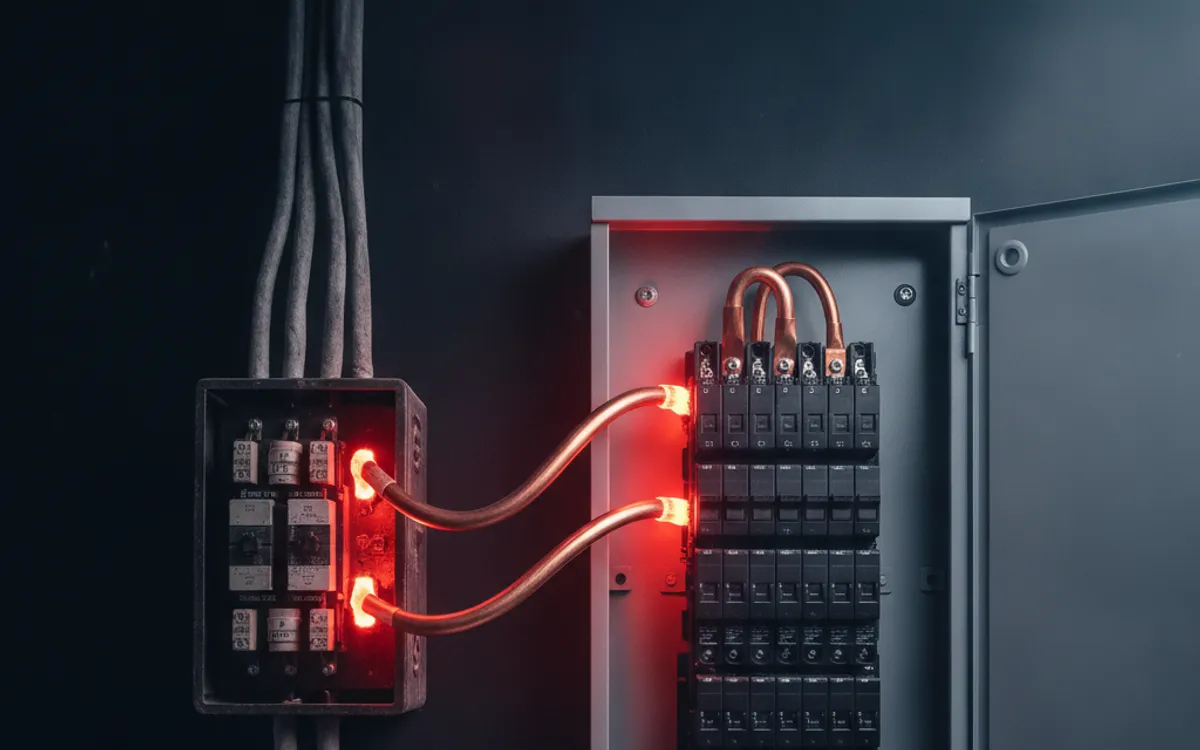
A panel-mounted Type 2 surge protective device is what most Calgary homes need, and it is what "whole-home surge protection" usually refers to. It installs directly in or beside your electrical panel and protects every circuit downstream of it — lighting, outlets, the furnace, an EV charger, a solar inverter — from a single point of entry. Type 1 devices are typically installed on the utility side of the meter or in larger commercial and industrial applications, and are less common on a standard residential service. Point-of-use protectors — the surge-rated power bar under your desk or entertainment centre — are a separate, complementary layer that catches smaller, localized events and adds protection for particularly sensitive gear, but they do nothing for the furnace, the sump pump, or anything else in the house that is not plugged into them.
“A panel-mounted surge protector and a power bar are not doing the same job. One protects a single outlet; the other protects every breaker in the panel — and everything wired to it — from one point.”
Why Calgary homes are more exposed than people assume
Calgary's weather and grid conditions add up to more surge exposure than a lot of homeowners realize. Chinook winds can swing temperatures by double digits within hours, which means furnaces, heat pumps, and AC units are cycling harder and more often than in a steadier climate — and every cycle is a small surge event at the source. Summer brings a real hail and thunderstorm season across the region, with lightning activity on distribution lines well beyond city limits still capable of sending a surge down the wire into an urban home. And the stakes have gone up: a home with an EV charger, a solar inverter, a smart thermostat, security cameras, and a home office full of electronics has far more expensive, surge-sensitive equipment plugged in today than the same home did a decade ago. Overhead services, more common in older Calgary neighbourhoods and across acreage properties in Rocky View County and the Foothills, tend to see more line-side surge events than newer underground services — one more reason exposure varies house to house.
What whole-home surge protection actually costs in Calgary in 2026
Pricing depends mostly on your panel's condition and how much additional protection you want layered on top. These reflect typical Calgary market ranges, not a fixed quote:
- Panel-mounted Type 2 SPD on a panel with available breaker space: $300 to $700 installed, including the City of Calgary electrical permit.
- Panel already at capacity, requiring a small sub-feed or breaker rearrangement to make room: add $150 to $400.
- Point-of-use protection added for a home office, entertainment centre, or solar inverter monitoring equipment: typically $50 to $150 per location.
- Whole-home SPD installed at the same time as a panel upgrade or panel replacement: often a modest incremental cost, since the panel is already open.
What a proper installation actually involves
A surge protective device is new equipment tied directly into your panel, and it requires a City of Calgary electrical permit like any other panel modification — as we've covered in our guide to electrical permits in Calgary, that permit is what triggers the inspection confirming the device is correctly rated, properly grounded and bonded, and installed with the short, direct wiring run the manufacturer specifies. A poorly grounded or loosely connected SPD is close to useless — the whole point of the device depends on a clean, low-resistance path to ground. This is also where panel condition matters: a panel that is already crowded, or an aging panel with no listed SPD accessory available for it, can turn a straightforward SPD install into a broader panel conversation, the same way we see with generator interlock kits and EV charger installs.
The insurance and warranty angle
Most whole-home SPDs come with a manufacturer connected-equipment warranty — coverage toward repairing or replacing devices damaged by a surge that gets past the protection, provided the unit was installed and permitted correctly. That permit and inspection record is exactly the kind of documentation that matters if you ever need to make a claim, either through the manufacturer's warranty or your home insurance — the same principle we've covered in our broader guide to why permitted electrical work protects you. As homes carry more surge-sensitive equipment — EV chargers, solar inverters, smart-home systems — a documented, code-compliant SPD installation is a reasonable thing to mention to your insurance broker, particularly if you are already discussing coverage for that equipment.
Who actually needs whole-home surge protection
Not every home needs to rush out and install one tomorrow, but the case gets stronger quickly for homes with:
- An EV charger — a Level 2 charger is expensive equipment tied directly to the panel, exactly where a surge enters.
- A solar PV system — inverters are sensitive, surge-prone electronics that are costly to replace.
- A sump pump — a surge that takes out the pump during the storm that caused the surge in the first place is the worst possible timing.
- Smart-home, security, or home-office equipment — thermostats, cameras, networking gear, and computers are all vulnerable and rarely cheap to replace all at once.
- A hot tub or any equipment with an electronic control board — the kind of board that a surge tends to find first.
- An older overhead service, or a home that has already lost a device or two to unexplained electrical damage.
Common questions Calgary homeowners ask
Will a whole-home surge protector stop damage from a direct lightning strike? No device can promise that — a direct strike carries far more energy than any residential SPD is rated to absorb. What it protects against is the much more common event: the surge that travels in through the service line from grid switching, a distant lightning strike, or equipment cycling nearby. That is the overwhelming majority of surge damage homeowners actually experience.
Do I still need power bar surge protectors if I have whole-home protection installed? Yes, for your most sensitive gear. Layering point-of-use protection behind a panel-mounted SPD gives your most expensive electronics two lines of defence instead of one, and it is a small additional cost on top of the bigger investment.
Will installing an SPD cause nuisance tripping or interfere with my breakers? No. A correctly installed SPD sits alongside your breakers and monitors for surge events; it does not interrupt normal operation of any circuit and should be invisible in day-to-day use.
Does my panel have room for one? It depends on available breaker space and the panel's age and condition — the same load and capacity questions we walk through for any new panel-mounted device. An older or already-crowded panel may need a small modification first, which an electrician can identify on a service call.
From EV chargers and solar inverters to smart-home systems and hot tub controls, Calgary homes are carrying more surge-sensitive equipment than ever, and a single panel-mounted SPD is one of the more cost-effective ways to protect all of it at once. The team at Shock Stop installs whole-home surge protection across Calgary, Airdrie, Cochrane, Chestermere, Okotoks, Strathmore, Rocky View County, and the Foothills — permit pulled, properly grounded, and often bundled with a panel upgrade or generator install when it makes sense to do both at once. Reach out for an assessment of your panel and a straight quote before the next storm season.