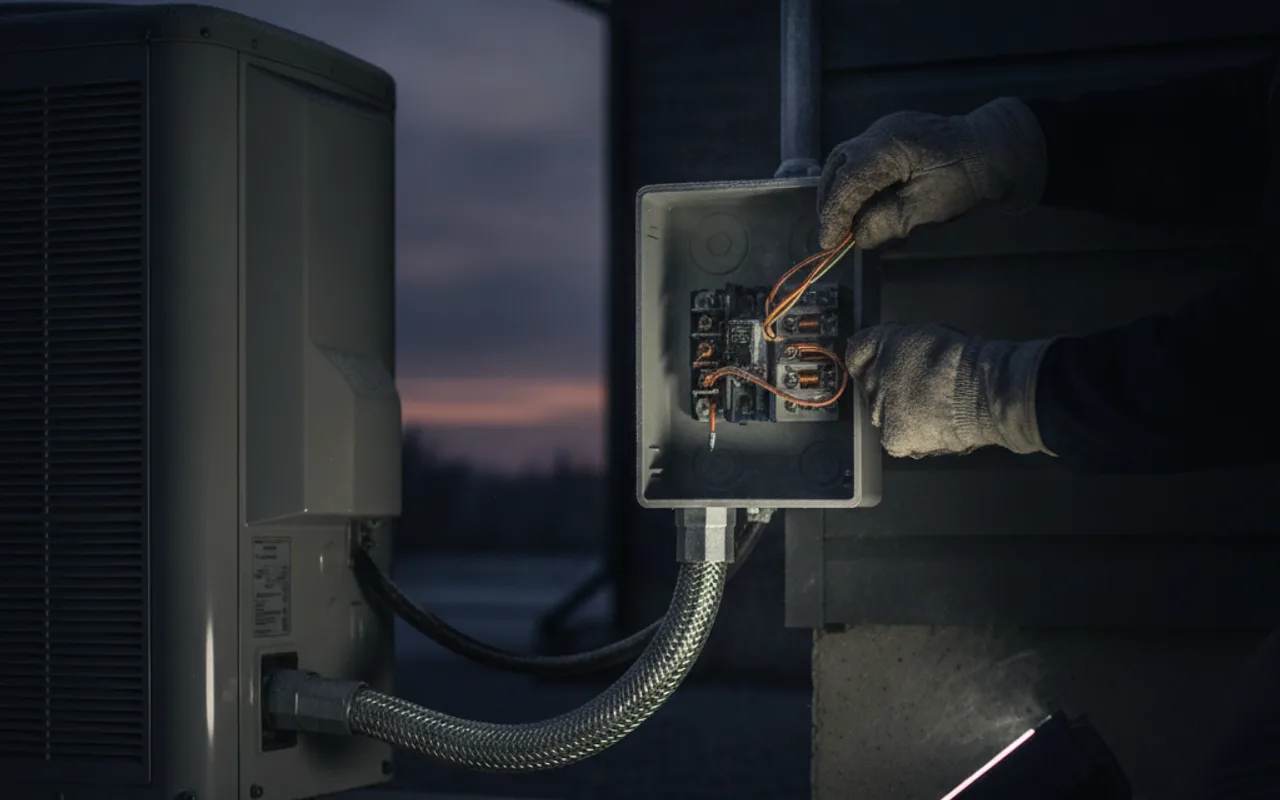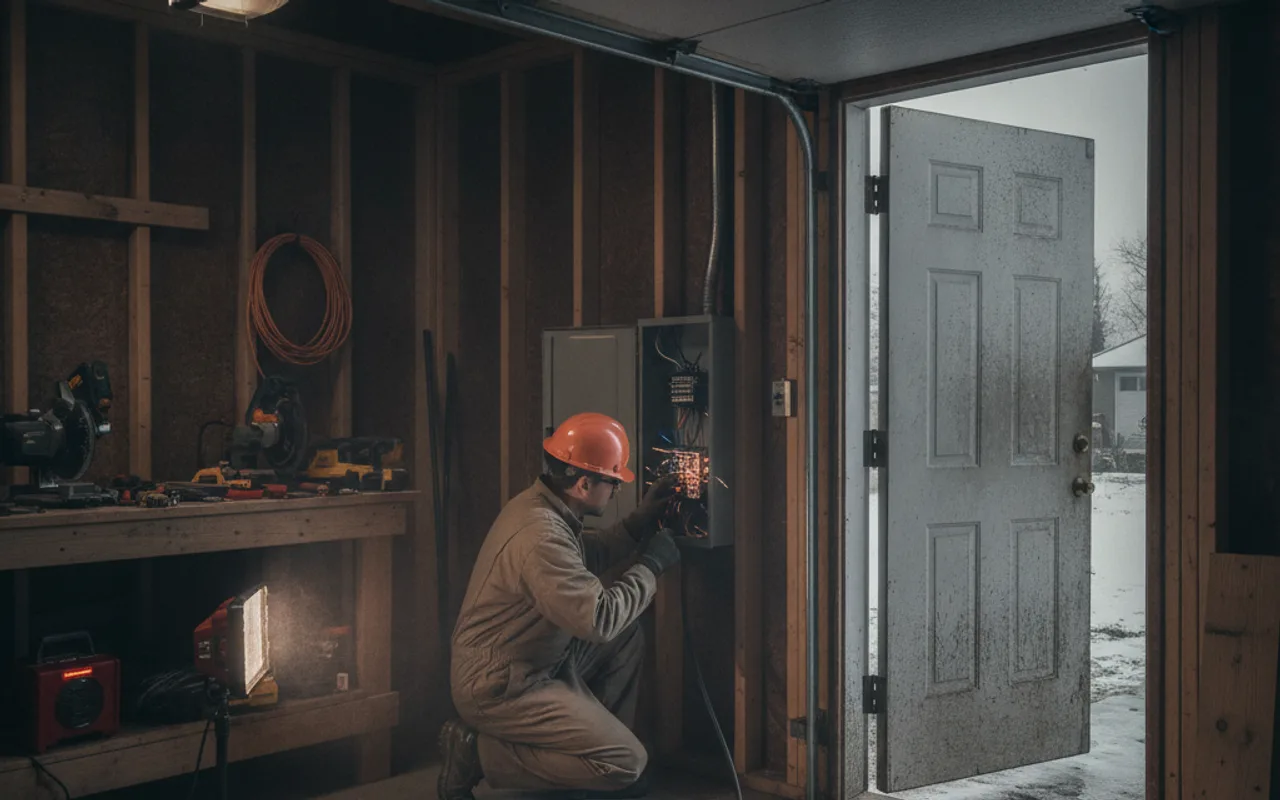
What a detached garage or shop sub-panel actually costs in Calgary — code requirements, permits, frost-depth trenching, and sizing it right the first time.
Garage sub-panel wiring in Calgary typically costs $2,200 to $4,500 installed for a straightforward 60-amp feed on a standard city lot, and $4,000 to $7,000 for a 100-amp panel sized for a heated workshop. That range covers the feeder conductor, conduit, the sub-panel itself, the disconnect and bonding, the City of Calgary electrical permit, and labour. Detached garages and heated shops are one of the most common builds in this city — almost every Calgary neighbourhood has them, from a single-car garage behind an inner-city bungalow to a three-bay heated shop on an Airdrie or Rocky View acreage — and the electrical is almost never as simple as running an extension cord out the back door.
“A garage sub-panel is not just an outlet at the end of a wire. It is a second electrical service with its own disconnect, its own bonding, and its own code requirements — sized wrong once, and you are trenching the yard a second time to fix it.”
What actually drives the cost
The spread in price comes down to a handful of concrete variables, and any honest quote should walk you through each one:
- Distance from the main panel — every extra metre of trenching and conduit adds cost, and it is the single biggest driver.
- Sub-panel amperage — a 60A feed for lights and outlets costs meaningfully less than a 100A or 200A panel sized for heat and tools.
- What has to be crossed — a concrete driveway, a fence line, or landscaping adds excavation cost a bare lawn run does not.
- Overhead vs. underground — a short overhead run between structures is cheaper than burying conduit, but most Calgary homeowners prefer underground for a cleaner yard.
- Panel capacity at the house — if your main service is already near its limit, a load calculation may show you need headroom created there first.
Sizing it right: 60A, 100A, or 200A?
Undersizing a garage sub-panel is the single most common regret we see, because trenching the yard twice costs far more than sizing it correctly once. The right size depends on what the space is actually for, today and in a few years — not just what fits the budget this month.
- A 60A sub-panel comfortably runs lighting, a couple of general-use outlet circuits, and a garage door opener — fine for storage or a light hobby space.
- A 100A sub-panel is the practical baseline for a heated workshop — it has room for an electric heater, a compressor, power tools, and a welder outlet without everything fighting for the same circuit.
- A 200A sub-panel is worth considering for a larger detached shop with multiple bays, serious heat load, or plans for an EV charger and heavy equipment together.
- If there is any chance you will finish the space further, add a second bay, or bring in an EV charger down the line, oversize the conduit now — pulling bigger conductors through existing conduit later is a fraction of the cost of a second trench.
The code requirements an inspector actually checks
A detached structure fed from the house is not treated as an extension of the same electrical system — under the Canadian Electrical Code as adopted in Alberta, it needs its own disconnecting means, and the feeder and grounding have to be sized and installed to specific rules. This is where DIY garage wiring most often goes wrong, and it is exactly what a City of Calgary electrical inspection is checking for.
“The disconnect at the garage is not optional and it is not decorative — it is what lets someone shut all power to that building in an emergency without walking back to the house.”
- A disconnecting means at or near the garage, so power to the structure can be cut without going back to the main panel.
- Correct feeder conductor sizing and overcurrent protection matched to the sub-panel's amperage.
- Proper grounding and bonding of the sub-panel — a detached structure has its own bonding requirements, not a simple extension of the house ground.
- GFCI protection on garage receptacles, as required in living and work spaces under the current code.
- Conduit and burial depth appropriate to the conductor type and Calgary's frost conditions, for any run that leaves the house underground.
Trenching and Calgary's frost line
Most garage sub-panel jobs involve running conduit underground between the house and the detached structure, and Calgary's freeze-thaw cycle is not something to guess at. A licensed electrician selects the conduit type and burial depth appropriate to the conductor and the soil conditions on your lot, so the feeder is protected from both physical damage and the ground movement that comes with our winters. As we've covered in our guide to hot tub wiring in Calgary, the same burial-depth principles apply to any conductor that leaves the house and crosses open yard — a garage feeder just tends to run a longer distance. If your property is a larger acreage lot rather than a standard city block, the trenching math changes again; we go deep on those longer-run, higher-amperage shop panels in our guide to acreage electrical costs around Calgary.
Heated workshops change the math
A garage used for storage and a garage heated year-round for real shop work are two different electrical projects, even if they look identical from the driveway. Electric heat is a large, continuous load, and it is usually the single factor that pushes a homeowner from a 60A sub-panel to 100A or larger.
- Electric unit heaters or baseboard heat in a heated shop can draw as much as everything else in the garage combined.
- A welder outlet needs its own dedicated, correctly sized circuit — sharing it with general-use outlets is how breakers trip mid-project.
- Air compressors and stationary power tools benefit from dedicated 240V circuits rather than sharing a single 120V run.
- If heat is in the plan, tell your electrician before the trench gets dug — it is the single detail most likely to change the sub-panel size.
Planning to charge an EV out there too?
A detached garage is a natural home for an EV charger, but it adds a large, continuous load to a panel that already has to cover heat, tools, and lighting. As we've detailed in our guide to EV charger installation in Calgary, code requires a load calculation before adding a charger — and on a garage sub-panel, that calculation has to account for everything else the sub-panel is already carrying. A 100A sub-panel with a heater and a Level 2 charger can get tight fast; running the numbers before the panel goes in avoids finding out the hard way that something has to be throttled back.
Permits and what protects you later
A garage sub-panel is not homeowner-permit territory in the way a light fixture swap is — it involves a new service disconnect, feeder sizing, and bonding decisions that a City of Calgary electrical inspection is specifically designed to catch before they become a hidden hazard. A licensed contractor pulls the permit as part of the job. If your main panel needs headroom before it can feed a new sub-panel, that is a related but separate project — we cover what that typically costs in our guide to 100A-to-200A panel upgrade costs in Calgary. Either way, permitted and inspected work is what protects your insurance coverage and your resale value if a future buyer or their inspector asks who wired the shop.
Questions Calgary homeowners ask us
Can I run power to my garage myself? In Alberta, a new sub-panel, feeder, and disconnect for a detached structure is licensed-electrician work, not homeowner-permit work — the disconnect and bonding requirements are exactly the kind of detail that gets missed without training, and they are what the inspection exists to catch.
How long does a garage sub-panel job take? A straightforward job — short trench, 60A or 100A panel — is usually one to two days of on-site work, plus scheduling the inspection. Longer runs, concrete cutting, or a main panel upgrade first will stretch that timeline.
Does my older Calgary home need a panel upgrade first? Only if a load calculation shows your main service does not have room to spare. Many 200A homes have plenty of headroom; older homes still on 100A service, especially with a suite, hot tub, or existing heavy loads, are more likely to need the main panel addressed before the garage sub-panel goes in.
What is the best time of year to book this in Calgary? Trenching is easiest before the ground freezes, so spring through early fall is the practical window for underground runs. If you want the shop wired and heated before winter, book the trenching work while the ground is still workable.
Do I need a permit if the garage already has some wiring in it? Yes — adding or upgrading a sub-panel, feeder, or disconnect requires a permit regardless of what wiring was already there, and it is the right opportunity to have an electrician confirm the existing wiring was done properly in the first place.
If you are planning a detached garage, a heated workshop, or a shop that needs to handle tools, heat, and maybe an EV charger down the line, the team at Shock Stop can size the sub-panel correctly, handle the trenching and permit, and get it inspected right the first time — across Calgary, Airdrie, Cochrane, and out into Rocky View County and the Foothills. Reach out for an on-site assessment and a straight quote before you break ground.