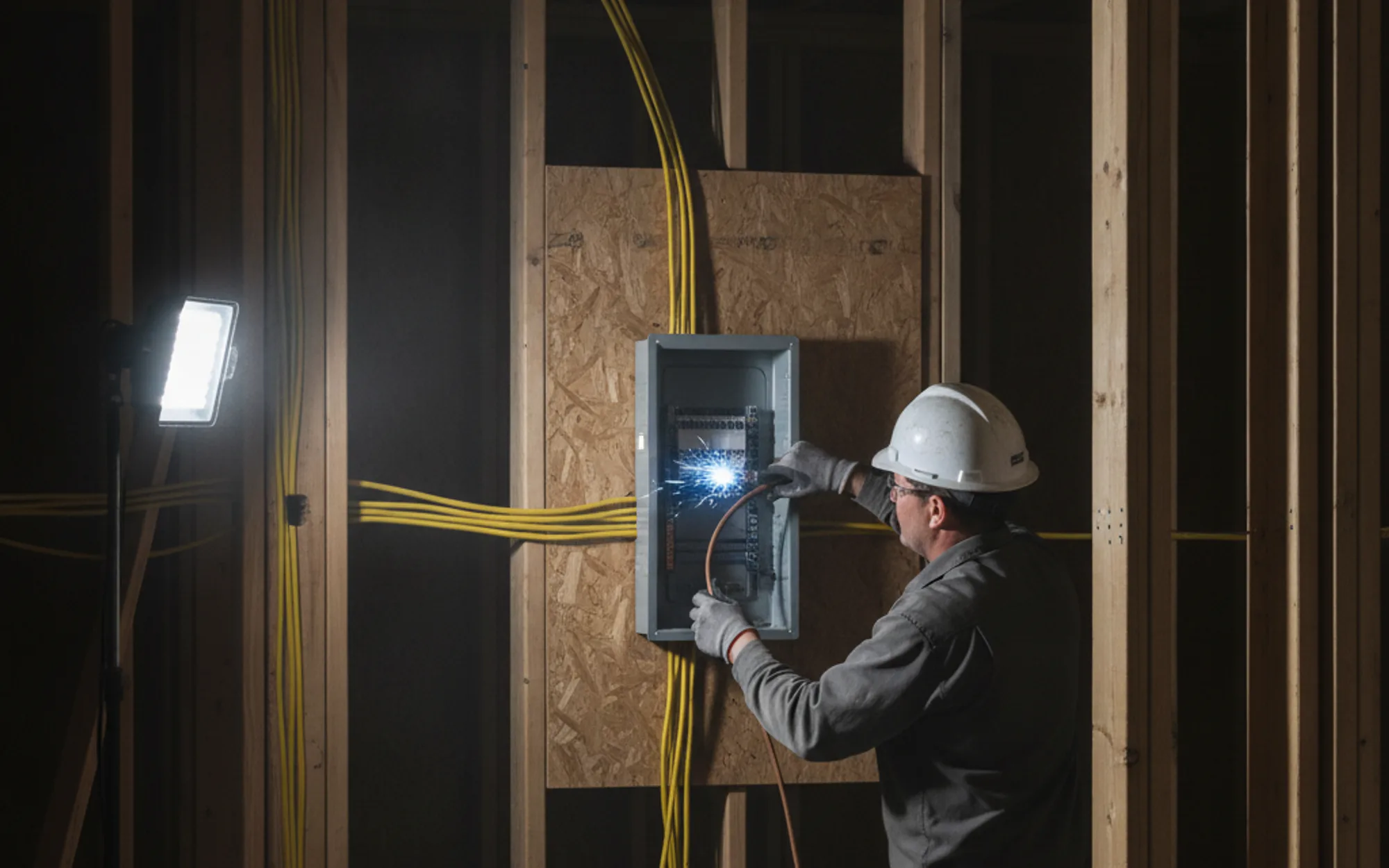

Renovation Electrician in Calgary
The electrical side of kitchen, bathroom and basement renovations, additions and garages: capacity checks, permits, rough-in, inspections and a clean finish. We work directly for homeowners running their own reno and as the electrical trade for general contractors and builders.
- Electrical scope only, done properly, for homeowners, general contractors and builders
- Load calculation before the design is final, so panel work is planned, not discovered
- Permit pulled and rough-in and final inspections booked for you
- Kitchen, bath, basement, addition and garage circuits planned together
- Old or unsafe wiring shown to you and priced in writing before extra work starts
- Clean, labelled work in homes people are still living in
Your renovation's electrical scope, handled by one trade
We aren't a general contractor, and we don't pretend to be. We do the electrical part of a renovation, and we do it thoroughly: planning circuits, checking the panel, pulling the permit, roughing in before drywall, booking inspections, and coming back to install devices and fixtures once the finishes are in. Homeowners who manage their own renos hire us directly; general contractors, builders and landowners bring us in as their electrical trade. Either way, you get one point of contact for everything with a wire in it. Most renovations happen in homes people are still living in, so we keep the work area tidy, plan power shutdowns with you ahead of time, and leave the panel labelled so you know what every new breaker feeds.
Kitchens: plan the circuits before the cabinets
Kitchens pack more electrical load into less space than any other room, so the circuit plan needs to be settled before cabinets are ordered. Fixed appliances such as the range, dishwasher and built-in microwave are usually planned on their own circuits, and counter receptacles follow code rules for spacing and protection that an island or peninsula can complicate. Alberta has enforced the 2024 Canadian Electrical Code since April 1, 2025, and we lay out the kitchen to it. Switching to an induction range or adding a second oven changes the load, which sends us back to the panel. Lighting belongs in the same plan: under-cabinet strips, dimmable pot lights and pendants centred on an island that hasn't been built yet. Our GFCI and AFCI guide explains the protection you'll likely see in a renovated kitchen.
Bathrooms: fans, heated floors and moisture
Bathroom electrical is mostly about water and air. Receptacles near a sink need ground-fault protection, and anything close to a tub or shower has placement rules we check before rough-in, not after the tile is set. A properly sized exhaust fan, vented outdoors and on a switch or timer people will actually use, protects the new finishes from moisture. Heated floor mats are wired through a thermostat matched to the mat, often on a circuit of their own. Add vanity and mirror lighting, a towel warmer or a bidet seat that needs a plug, and a small room can call for several new runs. Planning them together means one set of holes through the framing instead of three.
Basement development, and when it becomes a suite
Finishing a basement usually means new branch circuits, lighting for rooms that used to be one open space, receptacles along new walls, and smoke and CO alarms where the plan calls for them. The layout decision that matters most is the kitchen. The City of Calgary says a basement with both a kitchen and a bathroom has to be developed as a secondary suite, and a wetbar in a regular basement can't include a means of cooking such as a stove, cooktop, oven or microwave. A suite brings its own electrical requirements and permits, so if a rental or family suite is even a possibility, tell us early and we'll wire it for the suite path from the start instead of reworking it later. Our secondary suite page covers that work in detail.
Additions, garages and outbuildings
An addition can often be fed by extending circuits from the main panel, but a large addition or a detached garage frequently justifies a sub-panel of its own. Garages are where 240-volt circuits show up: a heater, a welder or compressor, a hoist, or an EV charger now or later. Running conduit for a future charger while the walls are open costs little compared with retrofitting it afterward. For detached garages and shops fed underground, the trench route has to be checked for buried lines first; ENMAX directs people to Utility Safety Partners at 1-800-242-3447 to locate buried power lines. We size the feeder for what the building will be doing in ten years, not just this winter. Our garage and shop sub-panel guide walks through the choices.
Check the panel before you add the load
A renovation is often the moment a house outgrows its service. The City of Calgary says that before adding air conditioning, EV charging, a heat pump, battery storage, electric heat, a hot tub or a new suite, you should have a registered electrical contractor confirm the home can carry the extra load, and load calculations are one of the things a homeowner permit doesn't allow. If the numbers don't work, there are two routes: upgrade the service, which the electrician arranges with ENMAX, or install an energy management system that shares capacity between loads. We run the calculation while quoting, so a service upgrade becomes a planned line item rather than a mid-project surprise. Older 100-amp and Federal Pioneer panels often end up in that conversation.
Permits and inspections, explained plainly
The City of Calgary requires an electrical permit for new wiring and for extending or altering existing branch circuits; replacing a light fixture on its own doesn't need one. A homeowner permit is only for an owner who lives in the home and does the work personally. You can't pull one on behalf of someone you've hired, and electrical contractors aren't allowed to work under a homeowner permit; they must get their own. Homeowner permits also exclude the main service, panel and meter base, EV charging, air conditioning, solar, battery storage and load calculations. When you hire us, we pull the permit and book the inspections: rough-in while the walls are open, and final once devices and fixtures are in. Our Calgary permit guide goes into more depth.
When the walls come open and old wiring turns up
Demolition is when a house tells the truth about its wiring. Aluminum branch circuits in homes from roughly 1965 to 1975, knob-and-tube in older inner-city houses, junction boxes buried behind drywall, ungrounded circuits or an earlier owner's unpermitted work all appear once the finishes come off. When we find something, we stop, show you or your contractor what it is, explain the options, and put any change in scope and price in writing before carrying on. If the problem is unpermitted wiring that's already covered up, the City allows it to be permitted afterward, but a homeowner permit can't be issued for it; the owner has to hire a licensed electrical contractor to have it inspected. Dealing with it during the reno beats discovering it at resale.
We handle renovation electrical across Calgary, from older bungalows being opened up for the first time to newer homes getting their basements finished, and in Airdrie, Cochrane, Chestermere, Okotoks, Strathmore, High River and acreages in Rocky View County and the Foothills. Inside Calgary, the City issues the electrical permit and inspects the work. Outside the city, the permit path depends on the municipality, and we confirm it for your address before work starts.
Renovation Electrical Work — your questions, answered
Do I need an electrical permit for a renovation in Calgary?
Almost always, if the renovation adds new wiring or extends or alters a branch circuit. The City of Calgary requires a separate electrical permit for that work, while replacing a fixture on its own doesn't need one. We pull the permit and book the rough-in and final inspections as part of the job.
Can I pull a homeowner permit and have an electrician do the work under it?
No. A Calgary homeowner permit covers only work the owner-occupant does personally. You can't pull a permit on behalf of the person or company doing the work, and electrical contractors aren't permitted to work under homeowner permits. When you hire us, we take out the permit ourselves.
Do you work with general contractors and other trades?
Yes. Builders, general contractors and landowners are exactly who we like working with. We quote from drawings or a site walk, schedule rough-in around framing, plumbing and HVAC, and return for the finish once drywall and paint are done. We handle the electrical scope only; we don't act as the general contractor.
When should the electrician be brought into a renovation?
Before the design is final, and well before walls close. The circuit plan affects cabinet layouts, appliance choices and whether the panel needs work, and in Calgary a service upgrade has to be arranged with ENMAX. Bringing us in at the planning stage keeps rough-in on schedule instead of holding up the drywall crew.
Will my panel handle a kitchen renovation or new appliances?
It depends on the service size, what's already on it and what you're adding. The City of Calgary says to have a registered electrical contractor confirm capacity before adding loads like air conditioning, EV charging, a heat pump or a hot tub. We run the load calculation during the quote and lay out the options if it comes up short.
What happens if you find old or unsafe wiring inside the walls?
We stop, show you what we found, explain what it means and what fixing it involves, and give you the change in scope and price in writing before any extra work starts. Aluminum branch wiring, knob-and-tube and buried junction boxes are the usual finds in older Calgary homes.
Can wiring done without a permit be permitted afterward?
Yes, in Calgary, but a homeowner permit can't be issued for concealed wiring that was done without permits. To get it inspected, the owner has to hire a licensed electrical contractor. We open what needs opening, correct what needs correcting and take it through inspection.
Related electrical services

Ready to book renovation electrical work in Calgary?
Tell us about your project and we’ll reply with a clear scope and an up-front price — permit and inspection included, no surprises.
Request a free quote