Where GFCI and AFCI protection is required in Calgary homes under the Canadian Electrical Code — and what to do in older houses that predate the rules.
GFCI outlets in Calgary are required by the Canadian Electrical Code in any location where electricity meets water — bathrooms, kitchens within 1.5 metres of a sink, garages, and outdoors. AFCI protection is required on circuits serving bedrooms and living spaces. If your home was built or renovated after these rules came into force, the protection should already be in place. If it predates them, there is no automatic obligation to retrofit — but there are specific situations where an upgrade becomes required, and others where it is simply the right call for safety. This guide covers both: what each protection type does, exactly where the code requires it in Calgary-area homes, and how older houses fit into the picture.
“GFCI protection stops current from reaching you through a wet path. AFCI protection stops current from arcing inside your wall. They address different hazards, in different rooms — and your home needs both in the right places.”
What GFCI protection is and what it prevents
A GFCI — ground fault circuit interrupter — monitors the current flowing through a circuit. The moment it detects even a small amount of current leaking to an unintended path — through water, a wet countertop, or a person — it cuts power in milliseconds. That response speed is the whole point. A standard breaker protects against overloads that build over seconds; a GFCI protects against the ground fault that can cause cardiac arrest in a fraction of a second.
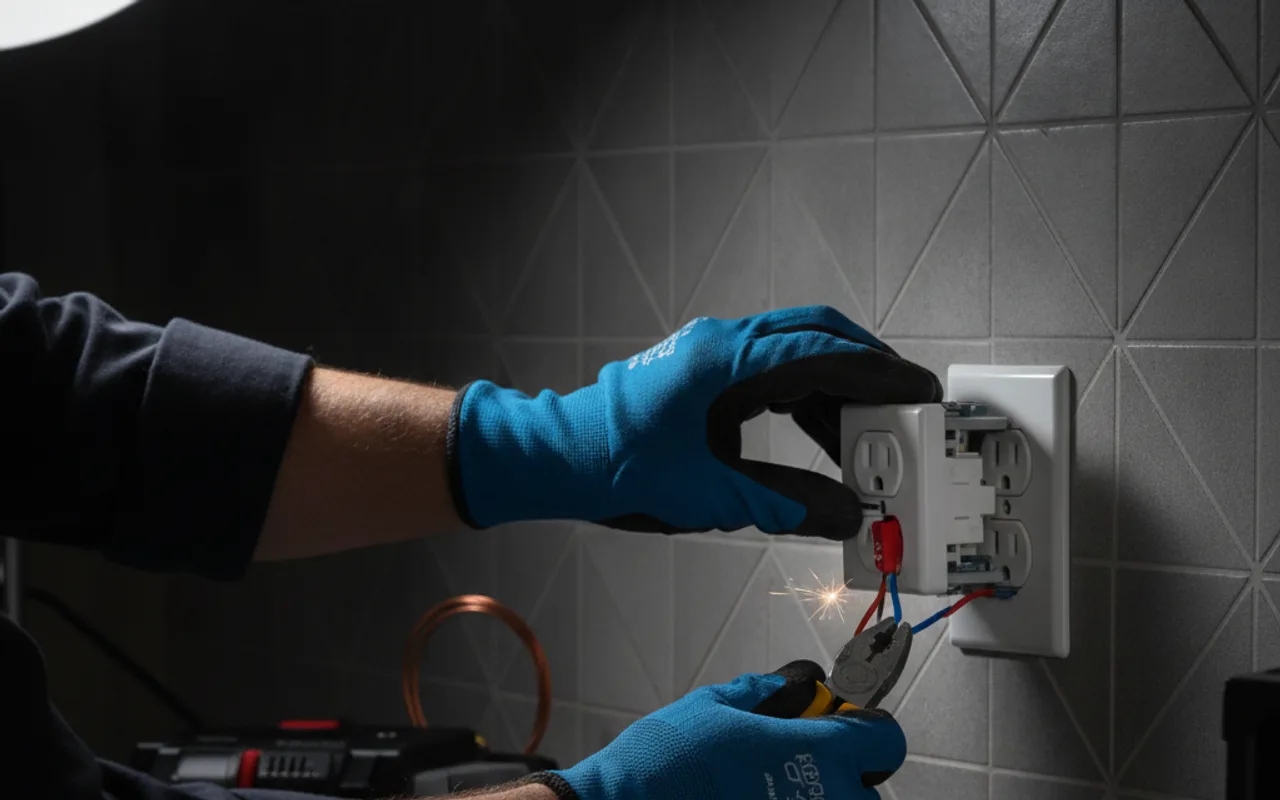
GFCI protection can live in the outlet itself — the receptacle with the test and reset buttons you recognize in a bathroom or kitchen — or it can be built into the circuit breaker in the panel. Either way, the protection is the same. One GFCI outlet wired correctly can protect downstream regular outlets on the same circuit, which is how an electrician adds protection to an older circuit without replacing every device in the run.
Where GFCI protection is required in a Calgary home
The Canadian Electrical Code — as adopted by Alberta and enforced through the City of Calgary electrical permit and inspection process — specifies where GFCI protection is mandatory. For a Calgary home, the required locations are:
- Bathrooms — any outlet within reach in a bathroom requires GFCI protection. This is the oldest and most consistently enforced requirement.
- Kitchen countertops — outlets within 1.5 metres of a kitchen sink require GFCI protection. In most Calgary kitchen layouts, that covers most or all counter receptacles.
- Garages — GFCI protection is required on garage outlets, including those used for tools, vacuums, and general use.
- Outdoor outlets — any exterior receptacle requires GFCI protection, along with a weatherproof in-use cover.
- Unfinished basements — outlets in unfinished basement spaces require GFCI protection. Finished basement living areas follow the AFCI rules covered below.
- Crawlspaces and damp utility areas — outlets in wet or damp utility spaces require GFCI protection.
The 1.5-metre kitchen rule catches homeowners off guard more often than any other. In a galley kitchen or a layout with an island, that radius covers a large portion of counter space. When a kitchen renovation adds outlets — or replaces existing ones with a permit — a licensed electrician will apply the requirement automatically as part of the job; our renovation electrician page covers the rest of a kitchen, bath or basement reno. This is also one of the more common deficiencies flagged in pre-purchase home inspections on Calgary homes from the 1980s and earlier.
What AFCI protection is and what it prevents
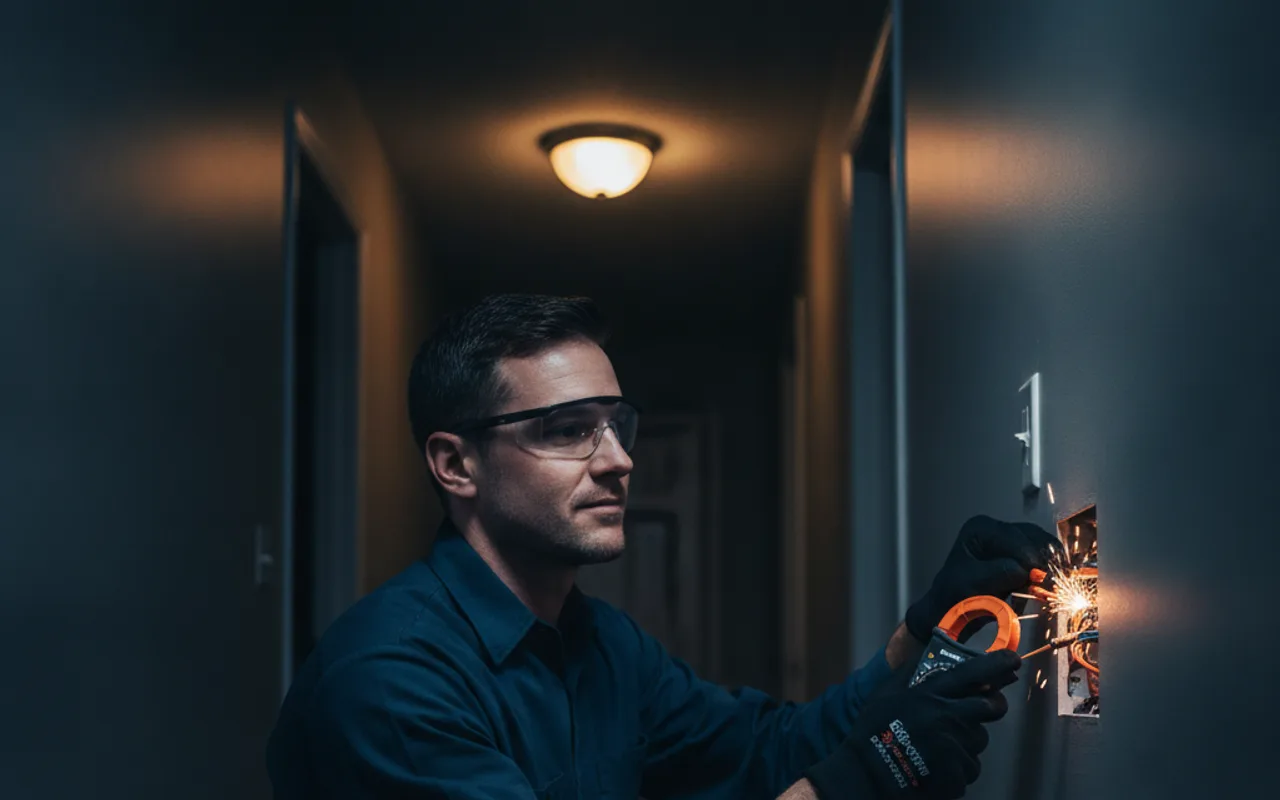
An AFCI — arc fault circuit interrupter — protects against a different failure mode. Where a GFCI watches for current leaking to ground through a wet path, an AFCI watches for arcing: the tiny electrical discharges that happen when a conductor is damaged, a connection is loose, or wiring is pinched or frayed inside a wall. A standard breaker will not detect a small arc — it only trips when the total current exceeds its rating. An arc can generate dangerous heat at a fraction of that current, entirely hidden inside a wall.
This is the failure mode behind a significant proportion of electrical fires. An arc that starts a fire behind a bedroom wall may draw only a few amps — well within the rating of a standard 15A breaker — while generating enough localized heat to ignite insulation or wood framing. An AFCI breaker detects the specific waveform signature of an arc and cuts the circuit before that heat can build. Standard breakers cannot perform this function; they are designed for a different kind of fault entirely.
“An arc inside a wall can draw far less current than a standard breaker is designed to trip on. That is precisely why AFCI protection exists — and why it is required in the rooms where people sleep and live.”
Where AFCI protection is required in a Calgary home
Alberta has adopted the Canadian Electrical Code requirements for AFCI protection, which apply to circuits serving living spaces — the rooms where wiring damage from furniture, nails, and decades of use is most consequential. AFCI protection is required on circuits serving:
- Bedrooms — the original and most longstanding AFCI requirement. Any circuit serving a bedroom requires AFCI protection.
- Living rooms, family rooms, and sunrooms — living-space circuits require AFCI protection on new construction and permitted renovations.
- Hallways, foyers, and stairwells — circuits serving these transitional spaces fall under AFCI requirements.
- Dining rooms — circuits serving dining areas require AFCI protection.
- Finished basements used as living space — a finished basement bedroom or family room triggers AFCI requirements on those circuits.
A key difference from GFCI: GFCI requirements apply based on location regardless of when the home was built. AFCI requirements apply at the time of new construction, panel replacement, or permitted renovation work. An older Calgary home whose living-room wiring was never disturbed is not automatically required to retrofit AFCI breakers on existing circuits. But the moment a permit is pulled for a bedroom addition or a basement development, AFCI protection becomes part of the job on those circuits.
GFCI vs. AFCI vs. dual-function: which do you need
Most homes need both protection types — in different places. The device you install depends on the room and the application:
- Kitchen, bathroom, garage, outdoors — GFCI protection at the outlet, or via a GFCI breaker in the panel.
- Bedroom, living room, dining room, hallway — AFCI breaker in the panel protecting the full circuit.
- Finished basement — AFCI on living-space circuits, GFCI on bathroom and laundry outlets.
- Bedroom circuit with an adjacent bathroom — a dual-function breaker (AFCI and GFCI combined) handles both requirements with one device.
Dual-function breakers combine AFCI and GFCI protection in a single panel breaker. They are increasingly standard in new construction and in panel replacements, satisfying both requirements wherever both apply — typically bedroom circuits that also feed an adjacent ensuite. The cost is higher than a standard breaker but lower than installing separate devices for each function. For a Calgary home getting a panel upgrade, specifying dual-function breakers on the right circuits is a clean, code-correct approach that does not require revisiting those circuits later.
Older Calgary homes and what applies to them
Calgary has a large stock of homes built in the 1960s, 1970s, and 1980s — communities like Varsity, Brentwood, Glendale, and Palliser are deep in that era — long before current GFCI and AFCI requirements existed. These homes are not automatically required to be retrofitted to current standards on existing, untouched wiring. The Canadian Electrical Code is enforced at the time of construction and at the time of permitted work — it is not retroactively applied to wiring that has not been disturbed.
The absence of an obligation is not the same as the absence of risk. A Calgary home from 1972 has bedroom circuits that have never had AFCI protection monitoring them for arc faults, and kitchen outlets that may predate GFCI requirements. Homes with aluminum branch wiring — common from roughly 1965 to 1975, and a topic our aluminum wiring safety guide covers in detail — add a compounding concern, because loose aluminum connections are among the conditions that produce the kind of arcing AFCI protection is designed to catch.
For homeowners having a panel replaced — whether because of an aging Federal Pioneer Stab-Lok panel, an undersized 100-amp service, or simply age — the new panel is loaded with breakers to current code. As our guide to panel upgrade costs in Calgary explains, a panel replacement is one of the most efficient moments to bring an older home's protection up to current standard, because the panel is already open and the incremental cost of specifying the right breaker type is low.
When GFCI or AFCI devices are failing
GFCI outlets have a typical lifespan of 10 to 25 years. In Calgary bathrooms and kitchens from the 1990s and early 2000s, many original GFCI receptacles are at or past that range. Signs to watch for:
- A GFCI outlet that trips and will not reset — this usually means a real fault has been detected and needs to be cleared, or the GFCI device itself has failed and needs replacing.
- A GFCI that resets but trips again immediately — something on the circuit is causing the fault: moisture, a failing appliance, or a damaged conductor.
- A GFCI that shows power on a tester but fails the push-to-test check — the protection mechanism has failed while the outlet still delivers power. This is a genuinely dangerous condition.
- An AFCI breaker that trips repeatedly without an obvious overloaded circuit — a common cause in older Calgary homes is a shared neutral from a multi-wire branch circuit predating AFCI requirements, which requires diagnosis rather than just a breaker reset.
A GFCI outlet that will not reset is not a push-harder problem. It signals that either the device has failed or the circuit has an active fault that needs to be found. Continuing to reset without diagnosing the underlying cause is the wrong move — particularly in a bathroom or kitchen where the fault likely involves moisture. A licensed electrician can find the root cause and fix the underlying issue, not just the symptom.
What GFCI and AFCI upgrades cost in Calgary
Cost depends on scope. These ranges reflect the Calgary market for typical residential work:
- Single GFCI outlet replacement (like-for-like) — typically $150 to $250 on a service call, including the device and labour.
- GFCI breaker added to an existing wet-area circuit in the panel — $250 to $450 depending on panel access and breaker type.
- AFCI breaker per circuit during a panel upgrade — a modest incremental cost per breaker when done as part of a panel replacement, since the panel is already open.
- Whole-home protection audit and upgrade — assessing and upgrading GFCI and AFCI coverage across all required locations, typically $800 to $2,500 depending on the age of the home and what is found.
A like-for-like GFCI outlet replacement generally does not require a City of Calgary electrical permit. Adding new GFCI-protected circuits, or adding AFCI breakers as part of a panel upgrade, does. As our guide to Calgary electrical permits covers, the permit triggers the inspection that confirms the protection is wired correctly — which matters most on safety-critical devices like these. In Airdrie, Cochrane, Okotoks, and surrounding communities outside Calgary, the same Canadian Electrical Code requirements apply, administered through Alberta's Safety Codes permitting process rather than the City.
Common questions about GFCI and AFCI outlets
Can one GFCI outlet protect multiple outlets downstream? Yes. A GFCI outlet wired with downstream outlets connected to its load terminals will protect those receptacles as well. This is how a licensed electrician adds GFCI protection to an older bathroom circuit without replacing every outlet in the run — one GFCI at the first position covers the rest. The caveat: if the GFCI trips, power to all downstream outlets is cut at the same time.
How often should GFCI outlets be tested? Monthly. Press the test button, confirm the outlet loses power, then press reset and confirm it is restored. The test takes ten seconds and tells you whether the protection mechanism is still active. In Calgary homes where original GFCI outlets have not been tested in years, the test sometimes reveals that a device is delivering power while its protection function has completely failed.
Do AFCI breakers cover the whole panel? No. An AFCI breaker protects only the specific circuit it serves. The bedroom circuit on an AFCI breaker is protected; the adjacent circuit on a standard breaker has no AFCI protection. An electrician reviewing your panel can identify which circuits have AFCI protection, which require it under current code, and what a targeted upgrade would involve.
For basement suites and secondary suite developments, both protection types come into play at once: GFCI on the bathroom and kitchen counter circuits, AFCI on the bedroom and living-space circuits. Our guide on basement suite electrical in Calgary covers how those requirements are woven into the full scope of a legal suite build.
Whether your home needs a single failed GFCI outlet replaced, a whole-panel assessment of GFCI and AFCI coverage, or a panel upgrade that brings all circuits to current code, the team at Shock Stop can assess your situation and give you a straight answer on what is required, what is recommended, and what it will cost — City of Calgary permit handled from the start. Reach out to book an electrical safety assessment.