A tripping breaker means the safety system is working — the question is why it keeps happening. Here are the real causes, from overloaded circuits to aging wiring, and when to call an electrician.
A breaker that keeps tripping is one of the most common calls we get from Calgary homeowners, and the good news is that a tripping breaker means the safety system is doing exactly what it is supposed to do. The real question is why it keeps happening — a breaker that trips once during an overloaded moment is a very different situation from one that trips every time you run the microwave and the kettle together, or one that will not stay reset at all. Here is how to tell the difference, and what each pattern actually means for your home.
“Quick answer: a breaker that trips repeatedly is doing its job — cutting power before an overload, short circuit, or ground fault turns into overheated wiring. The usual Calgary causes are too many appliances on one circuit, a failing appliance, or aging wiring. If a breaker will not stay reset, stop using that circuit and call a licensed electrician.”
The most common cause: too many things on one circuit
An overloaded circuit is by far the most frequent reason a breaker trips, and it is the least worrying of the causes on this list. Every circuit is rated for a maximum current, and a standard 15-amp household circuit has less headroom than people assume once a few higher-draw devices land on it at the same time. In Calgary homes this shows up seasonally — a space heater running through the winter alongside other loads on the same circuit, or a kitchen circuit asked to run a kettle, a toaster, and a microwave together during a busy morning.
- Space heaters — a genuine winter culprit in older Calgary homes with baseboard heat and thin circuit budgets.
- Kitchen counter appliances stacked on one circuit — kettle, toaster, air fryer, and microwave running at once.
- Hair dryers and other high-draw bathroom devices sharing a circuit with other loads.
- Holiday lighting added on top of an already-loaded circuit.
- Older homes with fewer circuits than a modern layout, so more devices end up sharing each one.
If the trip only happens with a specific combination of devices running together, the fix is often as simple as spreading the load — plugging the space heater or the kettle into a different circuit. If it happens no matter what is plugged in, or if unplugging things is starting to feel like a daily routine, the circuit itself may be undersized for how the room is actually used, which is worth having assessed rather than worked around indefinitely.
A short circuit or ground fault: a different, more urgent trip
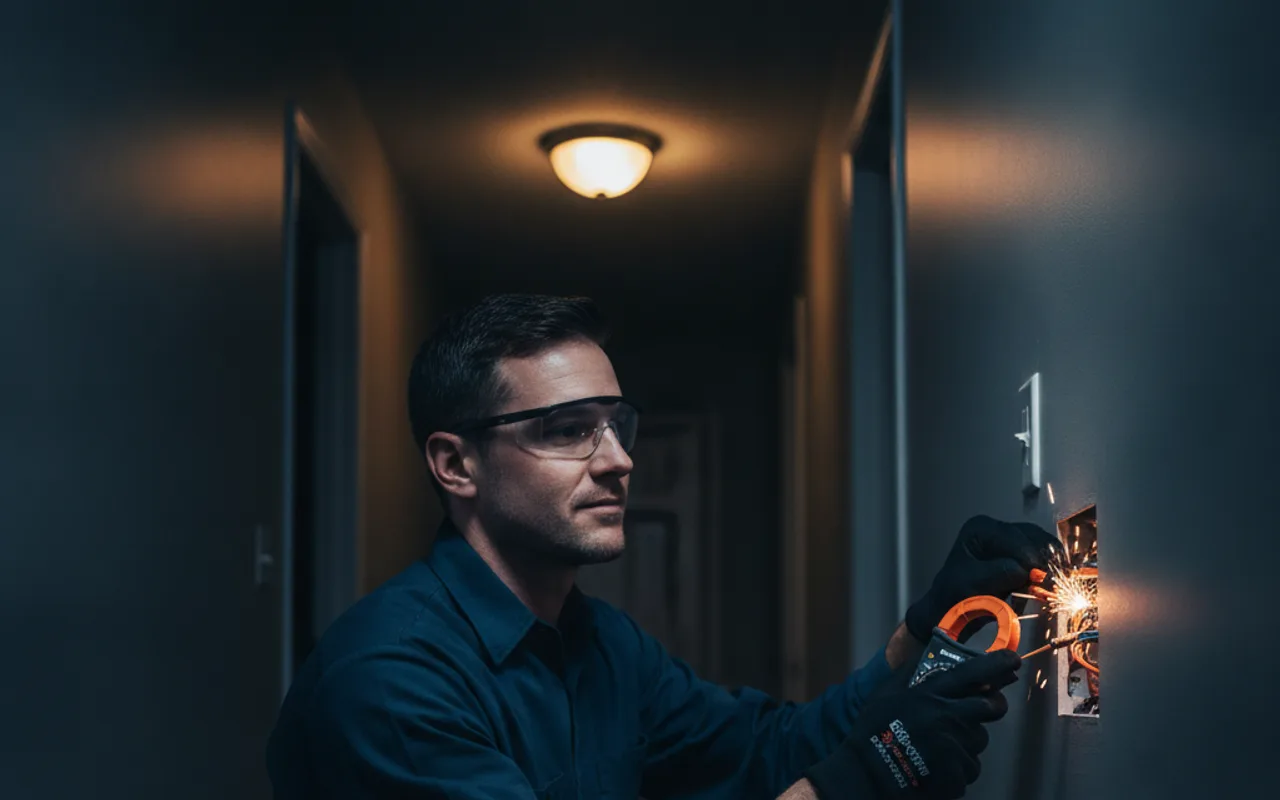
A short circuit or ground fault trips a breaker instantly and hard, with none of the gradual buildup of an overload. A short happens when a hot wire contacts a neutral or another hot wire; a ground fault happens when a hot wire contacts a grounded surface, like a metal junction box or appliance housing. Both send a sudden surge of current that the breaker is designed to cut immediately. If a breaker trips the moment you plug something in, trips within seconds of being reset with nothing new running, or you notice a burning smell, warm outlet plate, or scorch marks nearby, treat it as a short or ground fault, not an overload.
This is not a reset-and-move-on situation. Repeatedly flipping a breaker back on when it is tripping instantly is asking it to keep interrupting a real fault, and it is exactly the scenario where you stop using the circuit and get a licensed electrician to trace the fault before it is disturbed further. If there is smoke, a burning smell or scorching at the outlet or panel, treat it as an electrical emergency and call right away, after hours included.
Arc faults behind bedroom and living-room trips
If the tripping breaker serves a bedroom, living room, or another AFCI-protected circuit, an arc fault is worth considering. An arc fault is a small, intermittent electrical discharge — from a pinched wire, a loose connection, or a damaged cord — that an AFCI breaker is specifically built to detect and interrupt, even though the current involved is too small to trip a standard breaker. As we covered in our guide to GFCI and AFCI protection in Calgary homes, AFCI breakers are required on circuits serving bedrooms and other living spaces precisely because that kind of hidden arcing is a real fire-starting mechanism. An AFCI breaker that trips repeatedly without an obvious cause is telling you something is happening inside the wall or in a plugged-in cord, and it is worth having diagnosed rather than reset on repeat.
Aging wiring and connections make nuisance trips worse
The condition of the wiring behind the wall matters as much as what is plugged in. Homes with aluminum branch wiring — common in Calgary from roughly 1965 to 1975 — can develop loose, high-resistance connections at outlets and switches as the metal expands and contracts over decades, and that degradation can show up as circuits that trip more easily than they should. Homes with knob-and-tube wiring, mostly Calgary's pre-1950s inner-city communities, carry brittle, decades-old insulation that is more prone to faulting under load. And a panel itself can be part of the problem: older Federal Pioneer Stab-Lok panels are actually known for the opposite failure — breakers that do not trip reliably when they should, which is a distinct and separate concern we cover in our guide to Federal Pioneer panels in Calgary. If your home falls into any of these eras and the tripping has gotten more frequent over time rather than staying constant, the wiring itself, not just what is plugged in, deserves a look.
GFCI trips vs. breaker trips — know the difference
Not every "trip" happens at the panel. A GFCI outlet in a bathroom, kitchen, garage, or outdoor location can cut power at the outlet itself, in response to a ground fault as small as a few milliamps — often well before the panel breaker would ever react. If a specific outlet or a cluster of downstream outlets has gone dead while the rest of the room still has power, check for a GFCI outlet with a tripped reset button before assuming the panel is the problem. Our guide to GFCI and AFCI outlets in Calgary walks through exactly where that protection is required and how one GFCI outlet can protect several downstream outlets on the same circuit.
What to do when a breaker trips
- Unplug or turn off what was running on that circuit before you reset the breaker.
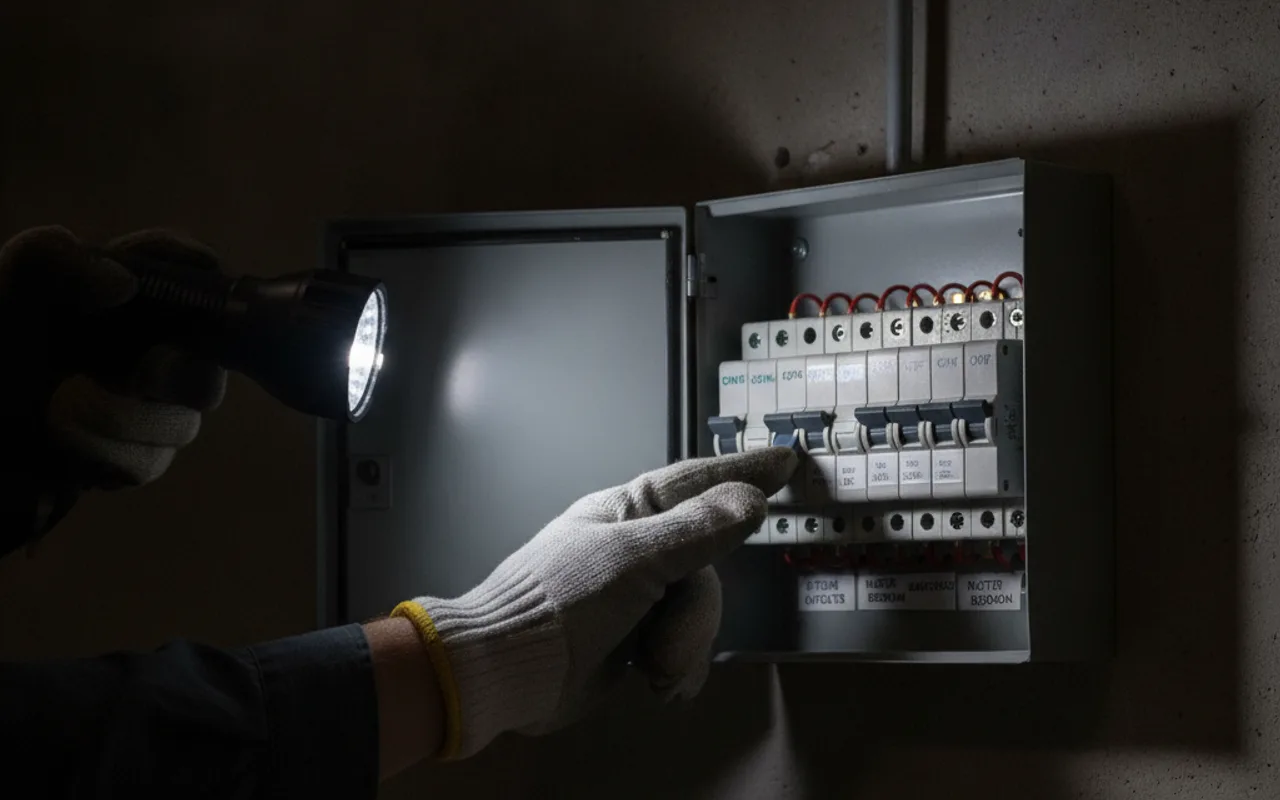
- Flip the breaker fully to OFF, then firmly to ON — a breaker left in the middle position will not reset properly.
- If it holds and stays on, bring devices back one at a time to identify what was overloading the circuit.
- If it trips again immediately with nothing plugged in, stop resetting it — that pattern points to a short or ground fault, not an overload.
- Never replace a breaker with a higher-amperage one to stop the tripping — the breaker is sized to protect the wire, and oversizing it removes that protection.
When it is a quick fix and when to call an electrician
Spreading out a genuinely overloaded circuit is something most homeowners can diagnose themselves — the pattern is obvious once you notice which devices are involved. Everything else on this list is licensed-electrician territory: a breaker that trips instantly and repeatedly, any burning smell or warm outlet plate, an AFCI breaker tripping with no clear cause, a circuit in an older home that has gotten steadily worse, or a breaker that will not reset at all. These are diagnostic calls, not guesswork, and finding the actual fault — rather than living with a circuit you avoid using — is the difference between a five-minute fix and a wall that stays a mystery.
A tripping breaker is your panel telling you something, and figuring out exactly what takes tracing the circuit, not just resetting it and hoping. The team at Shock Stop diagnoses tripping breakers, dead outlets, and circuits that never worked right across Calgary and the surrounding communities, and fixes the actual cause rather than the symptom. If a breaker in your home has become a regular problem, reach out and we will track it down.