Two-prong outlets in an older Calgary home aren't automatically dangerous — here's when a GFCI swap is enough, and when you actually need a rewire.
If your Calgary home still has two-prong outlets — the kind with no third, round grounding hole — you've probably wondered whether that's a genuine fire risk or just a quirk of the era the house was built. The direct answer: a two-prong, ungrounded outlet is not automatically dangerous by itself, but it means anything plugged into it is running without a safety ground, and there are two code-recognized fixes — a GFCI swap or a full rewire — depending on what your home actually needs.
“A two-prong outlet with no ground is not automatically unsafe — but the code-recognized fix is a GFCI-protected outlet, which adds real shock protection even though it does not add a true equipment ground.”
Why some Calgary homes still have two-prong outlets
Grounding requirements in residential wiring have tightened significantly since the mid-20th century. Many Calgary homes built through the 1950s, 60s, and into the 70s — including established communities like Varsity, Brentwood, Killarney, and Forest Lawn — were wired with two-conductor circuits, a hot and a neutral, with no separate ground wire run to the outlet, because that was simply the accepted standard at the time. This is a different issue from knob-and-tube wiring, a distinct pre-1950s wiring method we've covered separately, and from the aluminum branch-circuit wiring common in Calgary homes from about 1965 to 1975. A house can have perfectly sound copper wiring throughout and still have two-prong, ungrounded outlets everywhere, simply because nobody has ever upgraded the receptacles or run a ground conductor back to the panel.
Is it actually dangerous?
The two-wire system was code-compliant when it was installed, and it isn't an emergency the way a scorched panel or an active knob-and-tube splice can be. But it carries real, specific risks worth taking seriously:
- No path for fault current — if something inside an appliance shorts to its metal case, there is no ground wire to safely carry that current away. Depending on the appliance, that fault can just sit there until someone touches it.
- Cheater plugs and clipped ground pins — the most common real-world hazard isn't the outlet itself, it's homeowners snapping the ground pin off a three-prong plug, or using a two-to-three-prong adapter, to force a grounded appliance into an ungrounded outlet. That defeats the ground entirely and is more dangerous than simply leaving the outlet as-is.
- No surge or electronics protection — modern electronics, computers, and appliances with built-in surge suppression rely on a real ground to shunt excess voltage away. Without one, that protection does nothing.
- It's often a marker for other issues — a house that was never grounded is a house where the rest of the original wiring, connections, and panel are also due for a look.
The two fixes: GFCI swap vs. full rewire
Once you know an outlet is ungrounded, there are two legitimate paths forward, and the right one depends on the room, the appliance plugged in, and your budget.
The GFCI swap. The Canadian Electrical Code allows a two-prong outlet to be replaced with a GFCI-protected three-prong receptacle without running a new ground wire, as long as it's labelled to disclose that it has no equipment ground. A GFCI doesn't add a ground — it does something arguably more important for personal safety, cutting power in milliseconds the moment it detects current leaking to an unintended path. One GFCI outlet, wired correctly, can protect every ordinary outlet downstream of it on the same circuit, which is how our service and repair team can bring a whole ungrounded circuit up to a much safer standard in a single visit, without opening a single wall.
The full rewire. A GFCI swap protects people; it doesn't give you a true ground for equipment that actually needs one — a desktop computer, certain audio and AV gear, some workshop tools, and anything with a surge protector that depends on a real ground to function. If you're gutting a kitchen, finishing a basement, or simply tired of two-prong outlets throughout the house, running new grounded circuits with our residential wiring team is the permanent fix — and it's often bundled into a broader rewire if the home also has aluminum wiring or knob-and-tube behind the same walls.
“A GFCI swap is the fast, affordable way to make an ungrounded outlet safe to touch. A rewire is the only way to give it a true ground. Most Calgary homes end up using both — GFCI everywhere it's sufficient, real grounded circuits where equipment actually needs one.”
What it costs in Calgary
Costs scale with how much of the house is affected and whether walls need to open:
- Single outlet swapped to GFCI-protected, like-for-like — typically $150 to $250 including the device and labour.
- Whole-home GFCI conversion — auditing and upgrading every ungrounded outlet to GFCI protection, typically $800 to $2,000 depending on the number of circuits and how many outlets sit downstream of each GFCI.
- Partial rewire of specific rooms — kitchen, bathrooms, and a home office where a real ground actually matters — $2,000 to $5,000 depending on access.
- Full-home rewire — if the home also has knob-and-tube or aluminum branch wiring behind the same two-prong outlets, the outlet swap becomes part of the larger project we cover in our [knob-and-tube](/blog/knob-tube-wiring-calgary) and [aluminum wiring](/blog/aluminum-wiring-calgary) guides.
Renters and landlords: who's responsible
This comes up constantly from tenants in older Calgary rentals: ungrounded or non-functioning outlets are the landlord's responsibility to fix, not the tenant's. Alberta's Residential Tenancies Act requires landlords to keep the electrical system in a safe, functional condition, and a run of dead or genuinely hazardous outlets is exactly the kind of repair a landlord can't simply defer because it's inconvenient. If you're a landlord in Calgary, Airdrie, or Cochrane bringing an older rental up to a safer standard before a new tenancy, a GFCI conversion is usually the fastest, most cost-effective way to address ungrounded outlets across a whole unit.
Permits and what the inspection checks
A like-for-like GFCI outlet swap generally does not require a City of Calgary electrical permit — it's a direct device replacement, not new wiring. Running new grounded circuits, or any rewire, does require a permit and inspection, exactly as we've covered in our guide to Calgary electrical permits. That inspection confirms the new ground is actually bonded correctly back at the panel, not just present at the outlet — a detail that matters more than most homeowners realize, since a ground wire that isn't properly connected at the panel provides no real protection at all.
Common questions about two-prong outlets
Can I just use a three-prong adapter or clip the ground pin off my plug? No — this is the single most common way people turn a merely outdated outlet into a genuinely hazardous one. A cheater adapter or a clipped ground pin defeats the appliance's grounding entirely, with no GFCI protection standing in behind it either. If you need to plug a three-prong appliance into a two-prong outlet, get the outlet properly upgraded instead.
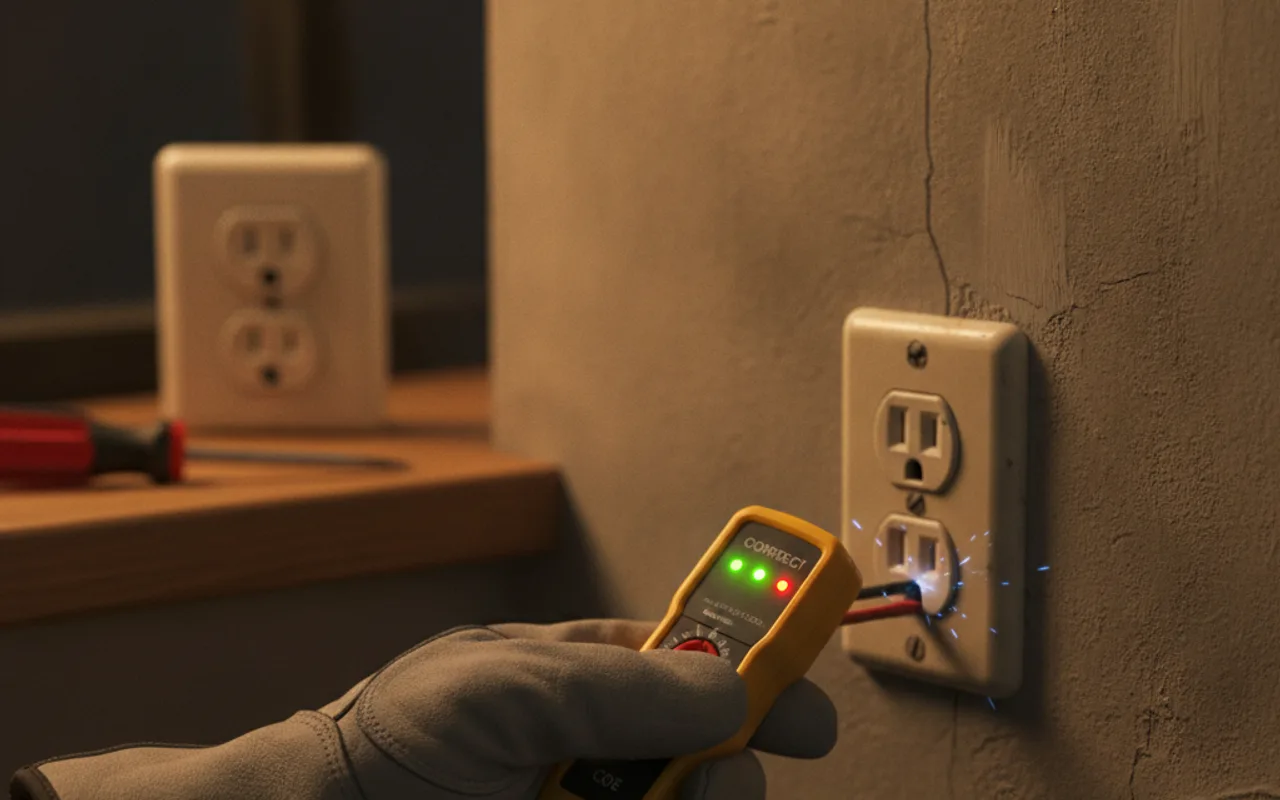
How do I know if my outlets are actually grounded? A simple three-light outlet tester from any hardware store will tell you in seconds whether an outlet that looks like a modern three-prong receptacle is actually grounded, or just cosmetically swapped without a real ground wire behind it — a surprisingly common shortcut in older Calgary homes that have changed hands a few times.
Will this affect my home insurance or a sale? Two-prong outlets alone rarely trigger the kind of insurance refusal that knob-and-tube or aluminum wiring can, but a pre-purchase electrical inspection will flag them, and an informed buyer will ask what it would cost to address. Documented, professional upgrades are exactly what turns that question into a non-issue.
Do I need to fix every outlet in the house at once? No. Most homeowners prioritize by room — kitchen, bathroom, home office, and anywhere a computer or sensitive electronics live — and phase the rest in over time or during a future renovation.
Two-prong outlets are common enough in Calgary's older neighbourhoods that they're rarely a reason to panic — but they are a reason to get a straight answer on what's actually behind your walls and which fix makes sense for your home. The team at Shock Stop can test every outlet in your house, tell you honestly whether a GFCI conversion is enough or a rewire is worth doing, and handle the permit and inspection if new circuits are needed. Reach out for an electrical safety assessment.