What a dedicated 240V outlet for a range, dryer, or shop tool costs in Calgary — panel capacity, permit fees, and how it differs from an EV charger circuit.
A dedicated 240V outlet in Calgary — for a range, dryer, or shop tool — typically costs $300 to $600 installed on a short run with panel room to spare, rising to $600–$1,200 for a longer or finished-wall run, and $1,200+ if the panel needs load management or an upgrade first. It requires a City of Calgary electrical permit and, on most modern services, is a same-day job.
Bought a new range, an electric dryer, or a 240V welder for the shop, and found out the outlet you have won't run it? A standard 120V circuit cannot deliver 240V — that takes a dedicated circuit, a double-pole breaker sized to the appliance, and a receptacle rated for the job. In Calgary, a 240V outlet installation cost typically runs $300 to $600 for a short, straightforward run with panel room to spare, climbing toward $1,200 or more if the run is long, the wall is finished, or your panel needs to make room first. It is one of the most common calls we get during a kitchen or laundry renovation, and one of the easier ones to get a straight answer on.
“A dedicated 240V outlet for a range, dryer, or shop tool typically costs $300 to $600 installed in Calgary when the run is short and the panel has room — permit included. Longer runs, finished walls, or a panel at capacity push that toward $1,200 or more.”
What actually needs a 240V circuit
Anything that draws more current than a standard 15 or 20 amp, 120V circuit can safely deliver needs its own 240V circuit, sized and protected for that specific load. The most common ones we install:
- Electric range or cooktop — usually a 40 to 50 amp circuit, depending on the appliance nameplate.
- Clothes dryer — typically a 30 amp circuit on a dedicated 4-wire receptacle.
- Shop equipment — a welder, a large air compressor, or a table saw with a 240V motor, sized to the tool.
- A dedicated workshop or garage sub-panel feed, when several 240V tools are involved rather than one outlet.
Two loads that look similar but are handled differently are worth flagging up front. An EV charger is also 240V, but it is a large, continuous load, and code requires a formal load calculation before it goes in — our guide to EV charger installation in Calgary covers what that involves and when an EVEMS load-management system is the smarter fix instead of a panel upgrade. A hot tub circuit is 240V too, but it carries its own bonding and GFCI-disconnect requirements that go beyond a simple outlet — see our hot tub wiring guide for that scope. And an outdoor heat pump condenser needs its own 240V disconnect sized to the compressor, which our heat pump electrical requirements guide walks through.
What it costs in Calgary
Pricing scales mostly with distance from the panel, whether the wall is open or finished, and whether the panel has capacity to spare. These are typical Calgary market ranges, not a fixed quote:
- Short run to a range or dryer location near the panel, with easy access: $300 to $600, including the breaker, receptacle, and permit.
- Longer run, a finished wall that needs to be opened and patched, or a second-floor laundry far from the panel: $600 to $1,200.
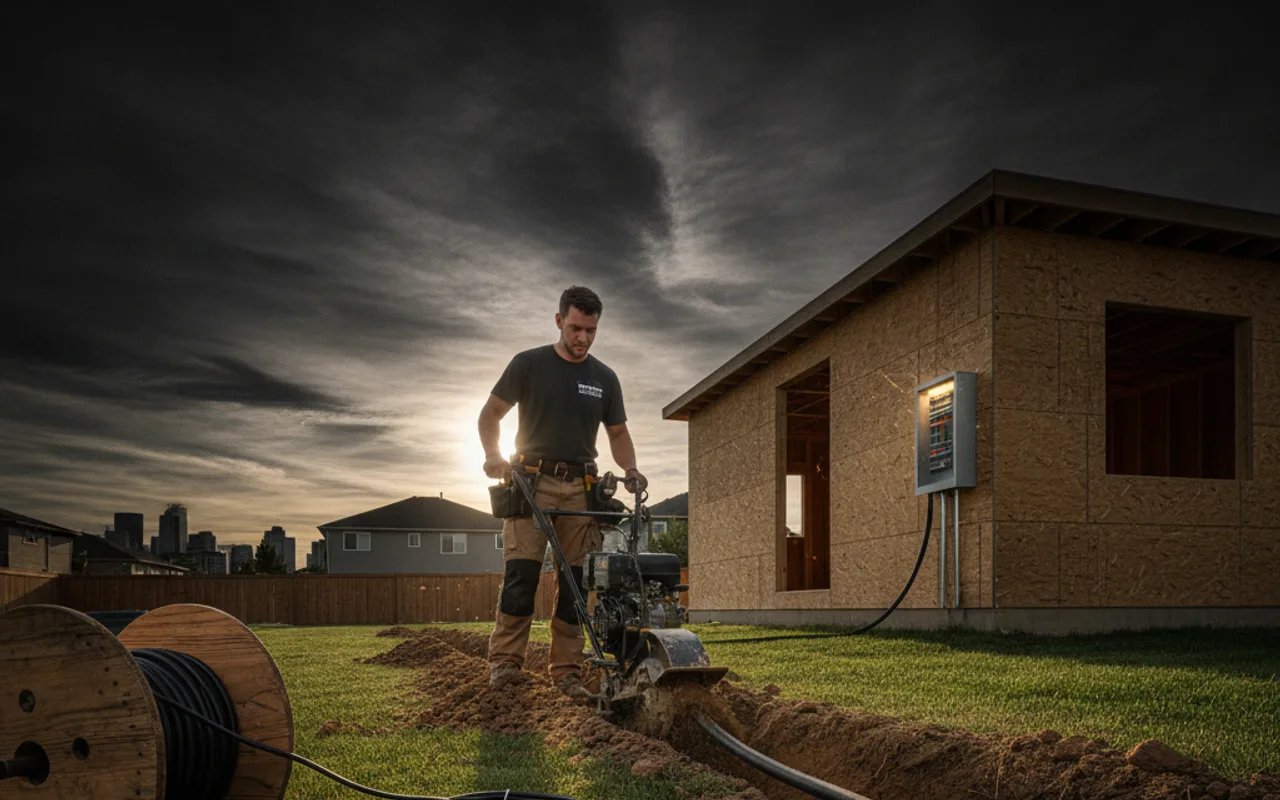
- Shop or garage circuit run through a detached structure, or several 240V outlets installed together: priced per run, often with savings from doing them in one visit — see our guide to [garage and shop sub-panel wiring](/blog/garage-shop-sub-panel-wiring-calgary) if you are equipping a whole workshop rather than adding one outlet.
- Panel already near capacity: add $1,200 or more for load management or a panel upgrade, the same fork covered in our guide to [panel upgrade costs in Calgary](/blog/panel-upgrade-cost-calgary).
Most Calgary homes on a modern 100A or 200A service have room for one more 240V circuit without issue — a range, dryer, or single shop tool is a well-defined, intermittent load. Where the cost moves is access: a basement laundry relocated to the main floor, or a kitchen island range that needs a run through finished ceiling and cabinetry, both add labour that has nothing to do with the wire itself.
Does your panel have room?
Before any new double-pole breaker goes into your panel, a licensed electrician checks whether your existing service can absorb the added load alongside everything already running — the dryer, the range, AC, a hot tub, an EV charger, whatever else is on there. On a newer 200A service this is rarely a problem. On an older 100A panel, especially one already carrying a secondary suite or baseboard heat, it is worth confirming before you commit to an appliance or a shop tool that assumes the outlet is a given. If the panel is tight, a load calculation will show it, and a panel upgrade or targeted load management becomes part of the conversation rather than a surprise on install day.
3-prong vs. 4-prong: what older homes should know
If your house predates a certain era, your dryer or range outlet may be an older 3-wire (3-prong) connection that uses the neutral conductor as the ground path — a method that was standard practice decades ago and is grandfathered today, meaning it does not have to be replaced on its own. Current code requires new range and dryer circuits to be 4-wire (4-prong), with a separate ground conductor. You do not need to rip out a working 3-wire outlet just because it is old, but if a wall is already open for a renovation, or you are buying a new appliance that ships with a 4-prong cord, upgrading to a proper 4-wire circuit while the access is there is the cleaner, safer long-term fix.
Do you need a permit?
Yes. A new 240V circuit is new electrical work, and it requires a City of Calgary electrical permit — the same rule covered in our overview of Calgary electrical permits. The City homeowner electrical permit is $116.50 for eligible homeowner-performed work. Alberta does allow a homeowner to pull that permit for eligible work in a home they own and occupy, but a 240V circuit means opening a live panel and landing a new double-pole breaker correctly — a loose lug or a mis-sized breaker is a fire risk that will not show itself until it fails, which is exactly the kind of job most homeowners hand to a licensed electrician. When you hire one, they pull the permit as part of the job, and the inspection that follows confirms the breaker, wire gauge, and receptacle all match the load.
Getting it done in one visit
A dedicated 240V outlet for a range, dryer, or shop tool is one of the more predictable jobs in residential electrical work — the load is well-defined, the code is clear, and on most Calgary homes it is a same-day install with the permit pulled and the inspection booked as part of the visit. Whether it is a kitchen renovation in the city, a laundry room relocation in Airdrie, or a workshop build on an acreage near Cochrane, the team at Shock Stop sizes the circuit to your actual appliance or tool, checks your panel has room before any wire gets pulled, and gives you a fixed, permit-included quote up front. Reach out for an assessment if a 240V outlet is on your renovation list.
Questions about this
How much does it cost to install a 240V outlet in Calgary?
A straightforward dedicated 240V circuit — for a range, dryer, or a piece of shop equipment — typically runs $300 to $600 installed when the run from the panel is short and the panel has room. A longer run, a finished wall that needs to be opened or fished, or a detached structure pushes that toward $600 to $1,200. These are Calgary market ranges, not a fixed quote.
Do I need a permit to install a 240V outlet?
Yes. A new 240V circuit is new electrical work and requires a City of Calgary electrical permit. The City homeowner electrical permit is $116.50 for eligible homeowner-performed work; a licensed contractor pulls the permit as part of the job when you hire one.
Is a 240V outlet the same as an EV charger circuit?
Not quite. Both run at 240V, but an EV charger is a large continuous load that Canadian Electrical Code requires a formal load calculation for before installing — see our guide to EV charger installation in Calgary. A range or dryer outlet is a smaller, well-defined load with a simpler sizing process, though the same panel-capacity question applies to both.
Can I install a 240V outlet myself in Alberta?
Alberta allows homeowners to pull an owner permit for eligible electrical work in a home they own and occupy, but opening a live panel to add a new double-pole breaker is exactly the kind of work most homeowners hand to a licensed electrician — a mis-sized breaker or a loose lug at the panel is a fire risk that is not obvious until it fails.
Does my old dryer or range outlet need to be replaced?
Current code requires new dryer and range circuits to use a 4-wire (4-prong) grounded connection. Older 3-wire (3-prong) outlets that use the neutral as a ground path are grandfathered and do not have to be replaced on their own, but if a wall is already open for another reason, most electricians recommend upgrading to a proper 4-wire circuit while it is accessible.